

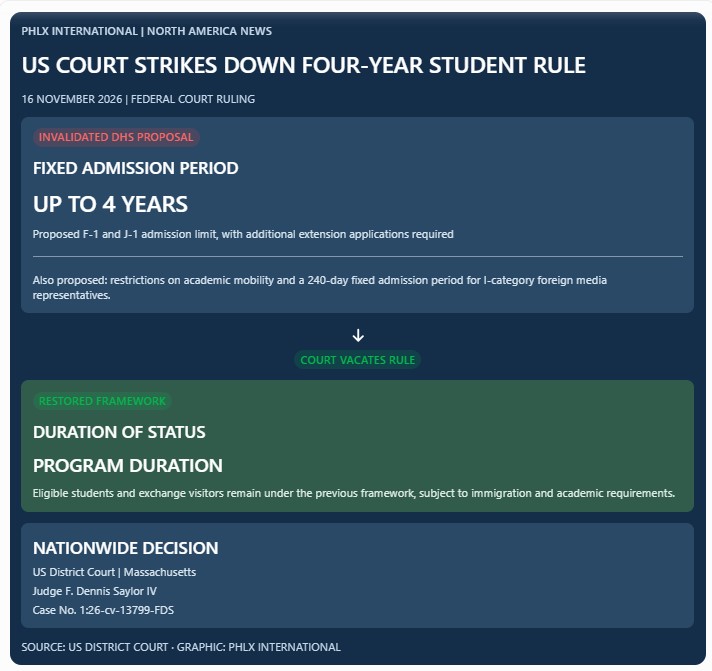
A federal judge in the United States has struck down a controversial immigration rule that would have introduced fixed admission periods of up to four years for international students, exchange visitors and certain foreign media representatives, restoring the longstanding Duration of Status framework nationwide.
The ruling, delivered on November 16 by Judge F. Dennis Saylor IV of the US District Court for the District of Massachusetts, represents a significant legal victory for international education organisations and universities that challenged the Department of Homeland Security’s (DHS) proposed changes.
The court granted the plaintiffs’ motion for summary judgment, rejected the government’s competing request and vacated the entire final rule under the Administrative Procedure Act.
The decision means that the previous immigration arrangements governing F-1 international students and J-1 exchange visitors remain in force, allowing eligible individuals to stay in the United States for the duration of their authorised academic or exchange programmes, provided they continue to comply with applicable immigration requirements.
The ruling is particularly relevant to international students from countries such as Nigeria, India, China and Ghana, whose nationals form substantial communities within American universities.
According to the Institute of International Education’s 2026 Open Doors report, 20,634 Nigerian students were studying at US higher education institutions during the 2025/26 academic year, representing 1.8 per cent of the country’s international student population.
The court’s decision removes the proposed four-year admission framework that had raised concerns about the ability of international students to complete lengthy academic programmes, pursue additional qualifications and move between educational institutions.
However, the ruling does not grant students unlimited permission to remain in the United States. They must continue meeting the requirements of their respective immigration categories.
Federal Judge Vacates DHS Immigration Rule
The judgment followed a legal challenge brought by a coalition of higher education and labour organisations against the US Department of Homeland Security.
The case, Presidents’ Alliance on Higher Education and Immigration et al. v. United States Department of Homeland Security et al., was filed in the District of Massachusetts under Civil Action No. 1:26-cv-13799-FDS.
The plaintiffs included the Presidents’ Alliance on Higher Education and Immigration, NAFSA: Association of International Educators, the Association of Independent Colleges and Universities in Massachusetts, the American Federation of Teachers and several labour organisations representing educators, researchers and journalists.
They challenged a DHS final rule published in the Federal Register on July 17, 2026, titled Establishing a Fixed Time Period of Admission and an Extension of Stay Procedure for Nonimmigrant Academic Students, Exchange Visitors, and Representatives of Foreign Information Media.
The regulation was scheduled to take effect on September 15, 2026.
However, on September 14, Judge Saylor issued a nationwide preliminary injunction postponing its implementation while the legal challenge continued.
The November 16 judgment went further by resolving the substantive legal dispute and vacating the regulation in its entirety.
In his decision, Saylor granted summary judgment in favour of the plaintiffs and denied the government’s cross-motion.
The court concluded that the regulation was arbitrary and capricious, an abuse of administrative discretion and otherwise contrary to law.
The ruling means the proposed fixed admission periods, additional extension-of-stay procedures and restrictions on academic mobility cannot take effect under the vacated rule.
What the Four-Year Rule Would Have Changed
The DHS regulation sought to replace the longstanding Duration of Status system with fixed admission periods for three categories of nonimmigrant visas.
These included:
- F-1 visas: International students enrolled in academic programmes at approved American educational institutions.
- J-1 visas: Exchange visitors, including researchers, professors, teachers, trainees and certain students.
- I visas: Representatives of foreign information media working in the United States.
Under the proposed arrangement, F-1 and J-1 visa holders would generally have received admission periods corresponding to their programmes, subject to a maximum initial period of four years.
Students and exchange visitors who needed additional time would have been required to apply directly to the Department of Homeland Security for an extension of stay.
The rule also introduced additional requirements governing changes to academic programmes and educational institutions.
For foreign media representatives under the I visa category, the proposed regulation included a substantially shorter fixed admission period of 240 days, with a separate extension process.
The government argued that replacing Duration of Status with fixed admission periods would improve immigration monitoring and strengthen enforcement against fraud and national security threats.
However, higher education organisations argued that the changes would create unnecessary administrative burdens, disrupt academic programmes and make American universities less attractive to international students.
The court ultimately found that the government had not adequately justified the regulatory changes.
Why the Court Ruled Against the Government
One of the central issues in the case was whether the Department of Homeland Security had properly evaluated the consequences of replacing the existing immigration framework.
The court found that DHS had failed to appropriately consider the costs and benefits of the regulation and had not adequately demonstrated that its stated objectives justified the restrictions.
The government had relied primarily on concerns about immigration fraud, abuse and national security.
However, the court found that those justifications did not sufficiently explain why the proposed four-year admission system was necessary or how it would effectively address the problems identified.
The judge also criticised the government’s failure to adequately consider less burdensome alternatives.
In particular, the court highlighted the existing Student and Exchange Visitor Information System (SEVIS), which already allows authorities to monitor international students and exchange visitors through information supplied by participating educational institutions.
Under the existing arrangement, designated school officials and exchange programme representatives provide information about students’ academic progress, addresses, enrolment and programme participation.
The court noted that DHS already possessed significant monitoring and enforcement tools through this system.
It therefore found that the government should have carefully evaluated whether improving the existing SEVIS framework could address its concerns without introducing the extensive restrictions contained in the new regulation.
The judge concluded that DHS had failed to demonstrate that the proposed changes offered sufficient benefits to justify abandoning the longstanding system.
Court Says Restrictions on Academic Mobility Exceeded DHS Authority
Another important aspect of the judgment concerned the restrictions the regulation would have imposed on students’ academic choices.
The proposed rule would have limited certain academic transitions, including pursuing additional qualifications at the same or a lower educational level, changing academic concentrations and undertaking certain joint-degree programmes.
These restrictions raised concerns among universities and international education organisations because academic development does not always follow a straightforward progression from one qualification to another.
For example, a student who had completed a law degree might legitimately wish to pursue an MBA, while a graduate researcher could decide to undertake a joint programme combining engineering and business.
The court found that the Department of Homeland Security had exceeded its statutory authority by imposing restrictions that were not reasonably related to the nature and purpose of the F-1 student visa programme.
Referring to the Immigration and Nationality Act, Judge Saylor explained that Congress had established the F-1 category to allow qualified foreign students to pursue genuine educational opportunities in the United States.
The court concluded that the restrictions introduced by DHS undermined that purpose rather than simply regulating the conditions of students’ authorised stay.
It therefore held that the academic mobility restrictions were contrary to statutory authority and provided an additional legal basis for vacating the regulation.
The decision is particularly significant for doctoral students, researchers and other international students whose academic programmes may require additional time or changes in direction.
Existing Duration of Status Framework Restored Nationwide
The most immediate consequence of the judgment is the continuation of the previous Duration of Status framework.
Under this system, F-1 students are generally admitted for the period during which they pursue a full course of study at an approved educational institution, together with any authorised practical training and applicable departure period.
J-1 exchange visitors are generally permitted to remain for the duration of their authorised exchange programmes, subject to the relevant programme requirements.
The existing framework also provides for I-category foreign media representatives based on the duration of their authorised employment activities in the United States.
For international students, the system provides greater flexibility when an academic programme takes longer than initially expected.
A student who maintains immigration status and makes normal academic progress does not ordinarily need to submit a separate application to USCIS simply because the original estimated programme period has been reached.
Where additional time is required, the existing regulations provide procedures through the educational institution’s designated school official.
The court’s judgment preserves these longstanding arrangements rather than introducing a new immigration benefit.
It also means that the additional extension-of-stay procedures and academic mobility restrictions contained in the July regulation will not take effect.
Universities have begun informing international students and scholars about the outcome.
Yale University’s Office of International Students and Scholars said that the existing Duration of Status framework remains in place and that students do not need to take action solely because of the court decision.
Students are nevertheless expected to continue complying with their existing immigration and academic obligations.
What the Ruling Means for Nigerian Students in America
The decision has particular relevance for Nigerian students pursuing undergraduate, postgraduate and research programmes in the United States.
Nigeria remains one of the significant countries of origin for international students attending American universities.
The Institute of International Education’s Open Doors 2026 report recorded 20,634 Nigerian students in the United States during the 2025/26 academic year, compared with 21,847 in the previous academic year.
The latest figure represents a decline of approximately 5.6 per cent.
Although the Open Doors figures include students enrolled at American institutions and those participating in Optional Practical Training, they provide an indication of the size of Nigeria’s educational community in the country. They are not a count of F-1 visa holders alone.
For eligible Nigerian students studying under F-1 status, the court’s decision means that the proposed four-year admission system will not replace the existing Duration of Status framework.
This is particularly important for Nigerians enrolled in doctoral programmes, medical and research-related academic pathways and other courses that may require more than four years to complete.
The decision also preserves the previous academic mobility arrangements, which allow eligible students to pursue approved educational changes and transitions in accordance with existing immigration regulations.
Nigerian exchange visitors participating in eligible J-1 programmes also benefit from the continuation of the previous framework.
However, the ruling does not automatically extend an individual’s visa stamp, authorise employment outside existing permissions or excuse a student from maintaining the required academic and immigration status.
Students who have questions about their individual circumstances should consult their university’s Designated School Official or an appropriately qualified US immigration lawyer.
Universities and International Education Organisations Welcome the Decision
The ruling has been welcomed by organisations representing American universities, international students and higher education professionals.
The Presidents’ Alliance on Higher Education and Immigration described the judgment as a major victory for the organisations that challenged the DHS regulation.
NAFSA also welcomed the outcome, noting that the court had set aside the regulation in its entirety.
The organisations argued that the proposed fixed admission periods would have created unnecessary uncertainty for international students and their educational institutions.
They also maintained that requiring students to seek additional immigration approval after a fixed period could have disrupted research projects, doctoral programmes and other long-term academic activities.
The court’s findings concerning SEVIS were particularly important to the plaintiffs because they demonstrated that the government had not adequately considered existing monitoring arrangements before introducing a substantially more restrictive system.
The organisations have also argued that maintaining a predictable immigration framework is important for America’s ability to attract international students, researchers and academic talent.
American universities rely on international students across a wide range of disciplines, including engineering, medicine, computer science, business and scientific research.
The ruling therefore has implications extending beyond individual immigration applications to the wider higher education and research sectors.
Can the US Government Appeal the Judgment?
Although the November 16 decision represents a significant victory for the plaintiffs, the legal dispute may not necessarily be over.
The government had previously appealed the September 14 preliminary injunction to the United States Court of Appeals for the First Circuit.
That appeal concerned the earlier order postponing implementation of the DHS regulation.
However, the appeal was placed on hold after the government requested additional time to allow the district court to resolve the underlying case.
The November 16 final judgment now provides a substantive decision on the merits of the dispute.
According to the Presidents’ Alliance litigation update, the government may separately appeal the final judgment and request a stay.
However, filing an appeal or requesting a stay does not automatically suspend the district court’s decision.
Unless the judgment is stayed or reversed, the vacated regulation cannot be implemented and the previous Duration of Status framework remains in effect nationwide.
The possibility of further litigation means that international students and universities will continue monitoring developments.
A Wider Debate Over US Immigration and International Education
The judgment comes amid broader debates about the United States’ approach to international students and immigration enforcement.
American universities have repeatedly raised concerns about policies that could make the country less attractive to foreign students and researchers.
International students contribute to academic research, university finances, innovation and the wider American economy.
According to the Open Doors 2026 report, the United States hosted 1,146,163 international students during the 2025/26 academic year, although total enrolment declined by approximately 2.7 per cent compared with the previous year.
New international student enrolments fell by 17.7 per cent to 228,123.
The court’s decision therefore comes at a time when universities are already dealing with uncertainty surrounding international recruitment and immigration policy.
The judgment does not resolve every issue affecting foreign students, including visa processing, entry restrictions, employment authorisation and other immigration requirements.
Nevertheless, it removes one major proposed regulatory change that had threatened to introduce additional uncertainty into academic planning.
For international students, the decision provides continuity in the rules governing their authorised stay.
For American universities, it preserves the flexibility required to support students undertaking lengthy and sometimes complex academic programmes.
What International Students Should Do Next
Following the judgment, eligible international students should continue operating under the existing immigration framework.
F-1 students should maintain their required course loads, comply with their approved programme conditions and keep their immigration records up to date.
J-1 exchange visitors should continue participating in their authorised programmes and follow the requirements of their exchange sponsors.
Students considering programme changes, school transfers or additional qualifications should consult their designated school officials to ensure that any proposed transition complies with existing regulations.
The court’s decision does not remove the need for valid immigration documentation or authorisation for activities such as employment and practical training.
Universities are also expected to update their international student guidance to reflect the final judgment.
The Department of Homeland Security may still pursue further legal options, but any subsequent development would need to be assessed against the existing court order.
For now, the November 16 judgment represents a major development in US international education policy.
By vacating the proposed four-year admission rule and restoring the longstanding Duration of Status framework, the court has preserved the ability of eligible international students and exchange visitors to continue their authorised programmes without the additional fixed-period extension system.
For thousands of Nigerian students and their families, as well as international students from other countries, the decision provides important legal and administrative clarity as they pursue educational opportunities in the United States.
Community
Comments
Keep discussion respectful and relevant. Comments never affect rewards.
No comments yet. Start a respectful conversation.