

Candidates representing Serbia’s Student List have been sworn in as members of parliament following their victory in the country’s October parliamentary elections, marking a significant change in the country’s political leadership after 14 years of Serbian Progressive Party (SNS) dominance.
The 140 newly elected lawmakers took their oaths during the inaugural session of Serbia’s National Assembly on Tuesday, November 17, following an election in which the student-backed movement secured an outright parliamentary majority.
The result ended the SNS’s parliamentary majority and opened the way for the incoming lawmakers to begin the process of forming a new government.
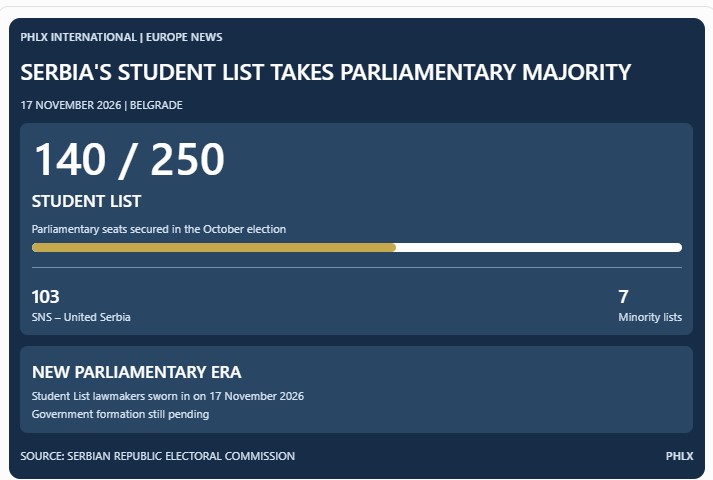
According to the Republic Electoral Commission’s final election results, the Student List secured 2,354,417 votes and won 140 of the National Assembly’s 250 seats.
The electoral list backed by former president Aleksandar Vučić, known as Aleksandar Vučić – United Serbia, received 1,731,323 votes and secured 103 seats.
Seven additional parliamentary seats went to political lists representing national minorities.
The new parliamentary majority now faces the task of selecting its leadership, establishing a cabinet and translating the promises made during the election campaign into government policy.
The outgoing administration will remain in caretaker office until parliament approves a new government.
Student List Lawmakers Form New Parliamentary Majority
The inaugural parliamentary session marks the formal entry of the Student List’s candidates into Serbia’s legislative institution.
The movement’s victory follows nearly two years of student-led demonstrations and wider public protests over government accountability, corruption allegations and institutional reforms.
Although the electoral list is associated with a student movement, its parliamentary candidates are not exclusively current students.
The candidates include academics, doctors, lawyers, scientists, professionals, activists, farmers and people from other backgrounds.
Many were selected through student assemblies and collective decision-making processes rather than conventional party nomination structures.
The movement presented itself as an alternative to the established political leadership and campaigned on commitments to address corruption, strengthen public institutions and improve the functioning of government.
Its electoral success has now placed it in a position to exercise parliamentary control, despite many of its incoming lawmakers having limited experience in elected politics.
The Guardian reported that the candidates had undertaken frequent meetings and simulated parliamentary exercises to prepare for their responsibilities.
The preparation reflects the challenge of moving from a protest-based movement into the practical work of legislation, parliamentary oversight and government formation.
Official Results Confirm 140 Seats for Student List
Serbia’s Republic Electoral Commission published its final report on the parliamentary election results on November 5, following voting held on October 25 and repeat voting at 53 polling stations on November 1.
The commission’s final allocation confirmed the Student List as the largest parliamentary group.
The results were:
- Student List – Students Are Winning: 2,354,417 votes and 140 seats.
- Aleksandar Vučić – United Serbia: 1,731,323 votes and 103 seats.
- Minority political lists: Seven seats collectively.
The allocation gives the Student List more than half of the 250 seats in the National Assembly, providing it with the numbers required to approve a government without relying on the main opposition bloc.
The Serbian Progressive Party, which had dominated the country’s political leadership for 14 years, will now occupy the opposition benches.
The seven minority representatives will also have seats in the new parliament, maintaining representation for different national communities.
The official allocation of parliamentary mandates was adopted by the Republic Electoral Commission on November 6.
The November 17 swearing-in therefore represents the next stage of the transition following the completion of the electoral process.
How Student Protests Developed Into an Election Victory
The Student List emerged from a prolonged period of public demonstrations that began following a deadly infrastructure disaster in the Serbian city of Novi Sad.
On November 1, 2024, part of the concrete canopy above the entrance to the city’s railway station collapsed, killing 14 people immediately. Two other victims later died from their injuries, bringing the death toll to 16.
The incident generated widespread public anger and demands for greater transparency concerning the railway station’s reconstruction, government oversight and accountability for those responsible.
Student groups subsequently organised demonstrations and university blockades, calling for information about the disaster and action against alleged corruption and institutional failures.
The protests expanded beyond the original incident, attracting participation from teachers, farmers, workers and other sections of society.
Demonstrators also called for political accountability, improved institutional independence and changes to the country’s governance arrangements.
As the protests continued through 2025 and 2026, demands for early parliamentary elections became increasingly prominent.
The Student List eventually developed into an electoral vehicle for the movement, bringing together candidates from different professional and academic backgrounds.
Its election campaign focused on institutional reform and anti-corruption measures.
The October 25 election provided the movement with an opportunity to translate its public support into parliamentary representation.
Its eventual victory gave it 140 seats, establishing a parliamentary majority that had not been achieved by the established ruling bloc.
Who Will Lead Serbia’s Next Government?
Although the Student List has secured a parliamentary majority, the identity and composition of Serbia’s next government remain unresolved.
The movement operates through collective decision-making, and its candidates have not announced a final choice for prime minister and the full cabinet.
Sarah El Sarag, a human rights lawyer and incoming member of parliament, told The Guardian that the wider student movement remained involved in the selection process alongside the parliamentary candidates.
The arrangement reflects the movement’s intention to maintain a connection between the student assemblies that helped organise its political campaign and the lawmakers now entering parliament.
However, it also presents a practical challenge.
Forming a government requires agreement on ministerial appointments, political responsibilities, legislative priorities and the distribution of authority between the incoming parliamentary leadership and the executive.
The movement must also demonstrate that its collective structure can function effectively within Serbia’s constitutional and parliamentary institutions.
The outgoing government, led by Prime Minister Đuro Macut, will continue operating in a caretaker capacity until a new cabinet receives parliamentary approval.
The incoming majority therefore has control of the legislative process but has not yet completed the transfer of executive power.
Parliament Faces a 90-Day Government Formation Deadline
The opening of the new National Assembly starts an important constitutional period for Serbia’s political transition.
Under the parliamentary timetable reported by the Associated Press, lawmakers have 90 days from the inaugural session to approve a new government.
During this period, the incoming majority must establish parliamentary leadership and complete the process of appointing a prime minister and cabinet.
The process will be closely watched because the Student List has no long-established governing structure comparable to that of the outgoing SNS administration.
The movement’s ability to reach agreement on appointments and policy priorities will be an important test of its organisation.
Failure to complete the government formation process within the prescribed period could lead to another parliamentary election.
For now, the outgoing administration remains responsible for routine government operations while the new parliamentary majority works towards establishing its cabinet.
The transition also coincides with preparations for another important political event: Serbia’s next presidential election, which must take place before the end of December 2026.
Vučić Moves Into Parliamentary Opposition
Former president Aleksandar Vučić remains an important figure in Serbian politics following his electoral defeat.
Vučić stepped down from the presidency in September 2026 before the parliamentary election, becoming the leading candidate on the SNS-backed United Serbia electoral list.
His political bloc subsequently lost its parliamentary majority to the Student List.
Following the result, Vučić entered the new political arrangement as an opposition lawmaker.
His party secured 103 seats, leaving it as the largest opposition group in the 250-member parliament.
The former president has criticised the incoming movement and indicated that he will continue opposing its political direction.
The Guardian also reported that he had threatened to organise counter-protests, raising questions about how the change in parliamentary power will affect political relations outside the National Assembly.
The SNS retains an established political organisation and experienced lawmakers, which means the incoming majority will face an organised parliamentary opposition.
The relationship between the two groups will influence debates over government appointments, legislation and institutional reforms.
Anti-Corruption Promises Will Face Their First Parliamentary Test
One of the Student List’s central campaign commitments was to strengthen accountability and address corruption.
Its programme included proposals for examining the assets and activities of public officials, investigating alleged misuse of public resources and strengthening institutions responsible for prosecuting corruption.
The movement also pledged changes affecting public broadcasting, education, healthcare and the administration of public services.
Other proposals included support for innovative businesses and farmers, affordable housing measures and access to free school textbooks.
These commitments will now face the practical demands of parliamentary legislation and government implementation.
The incoming lawmakers must determine which proposals can be prioritised, how they will be funded and which institutions will be responsible for carrying them out.
The railway station disaster that triggered the original protests remains an important part of the movement’s political background.
The demands for accountability following the collapse helped bring together different groups of demonstrators and contributed to the movement’s decision to enter electoral politics.
However, the transition from public demands to government action will require legal procedures, institutional cooperation and sustained political support.
The new parliamentary majority will therefore be judged not only by the promises it made during the campaign but also by the policies it eventually implements.
Foreign Policy and European Relations Remain Important Questions
Serbia’s political transition also has implications for the country’s international relationships.
The country maintains important economic and diplomatic relationships with the European Union, Russia and China.
It is also an EU candidate country, although its accession process has faced continuing questions concerning the rule of law, institutional independence, media freedom and relations with Kosovo.
The Student List’s election programme concentrated heavily on domestic institutional reform and anti-corruption commitments.
It did not establish detailed common positions on several sensitive foreign policy questions, including Serbia’s relationships with Russia and the European Union and the status of Kosovo.
This means that the incoming government will have to clarify its approach to these issues as it assumes executive responsibilities.
The European Union has previously indicated its willingness to support reforms concerning the rule of law, media freedom, corruption and democratic institutions in Serbia.
The direction taken by the new government could therefore influence the pace of Serbia’s European integration and its wider diplomatic relationships.
For now, the priorities of the incoming administration remain centred on the parliamentary transition and the formation of a functioning government.
A New Test for Serbia’s Political Institutions
The Student List’s entry into parliament represents a significant development in Serbia’s recent political history.
A movement that developed through student demonstrations and broader public mobilisation has secured an outright parliamentary majority and displaced the established ruling party from its previous position.
However, electoral victory is only the beginning of the governing process.
The incoming lawmakers must now establish an executive administration, agree on policy priorities and work within institutions that have been shaped by the previous political leadership.
They must also manage relations with an experienced opposition, respond to public expectations and address the domestic and international issues confronting Serbia.
The 90-day government formation period will be an early measure of whether the movement can translate its electoral mandate into a functioning administration.
The next phase will be particularly important for its anti-corruption commitments, institutional reform proposals and approach to Serbia’s international relationships.
For Serbia, the November 17 parliamentary session marks the beginning of a new political arrangement. Whether that change produces the institutional reforms promised during the election campaign will depend on the decisions made by the incoming majority and its ability to establish an effective government.
Community
Comments
Keep discussion respectful and relevant. Comments never affect rewards.
No comments yet. Start a respectful conversation.