

The United States and Russia are facing growing international pressure to accept stronger restrictions on autonomous weapons as governments gather in Geneva to debate whether artificial intelligence-powered military systems should be governed by legally binding international rules.
The discussions are taking place during the United Nations’ Seventh Review Conference of the Convention on Certain Conventional Weapons (CCW), which runs from November 16 to 20, bringing together representatives of 128 countries.
The conference is considering proposals that could establish an international framework governing lethal autonomous weapons systems (LAWS), particularly military technologies capable of identifying, selecting and engaging targets without direct human intervention.
However, major military powers, including the United States, Russia and Israel, are resisting proposals for a legally binding agreement, arguing that existing international humanitarian law already provides a framework for regulating military operations.
Their position has created a major diplomatic challenge for countries seeking stronger restrictions, with humanitarian organisations warning that advances in military artificial intelligence could make it increasingly difficult to maintain meaningful human control over decisions involving life and death.
The disagreement centres on whether governments should negotiate a binding international protocol, adopt non-binding guidelines or pursue a compromise arrangement that combines elements of both approaches.
UN Conference Faces Disagreement Over Autonomous Weapons
The Geneva meeting represents an important opportunity for governments to decide the future direction of international discussions on autonomous weapons.
The Seventh Review Conference is considering the findings of the Group of Governmental Experts on Lethal Autonomous Weapons Systems, which completed its latest work in September 2026.
The group produced a report identifying possible elements of an international instrument and other measures that could address the humanitarian, legal and security concerns associated with autonomous weapons.
Governments are now considering whether those findings should provide the foundation for formal negotiations.
The debate has gained urgency as artificial intelligence becomes increasingly integrated into military technology.
Modern military systems include drones, robotic platforms, surveillance equipment, missile systems and other technologies capable of processing information and performing functions with varying degrees of autonomy.
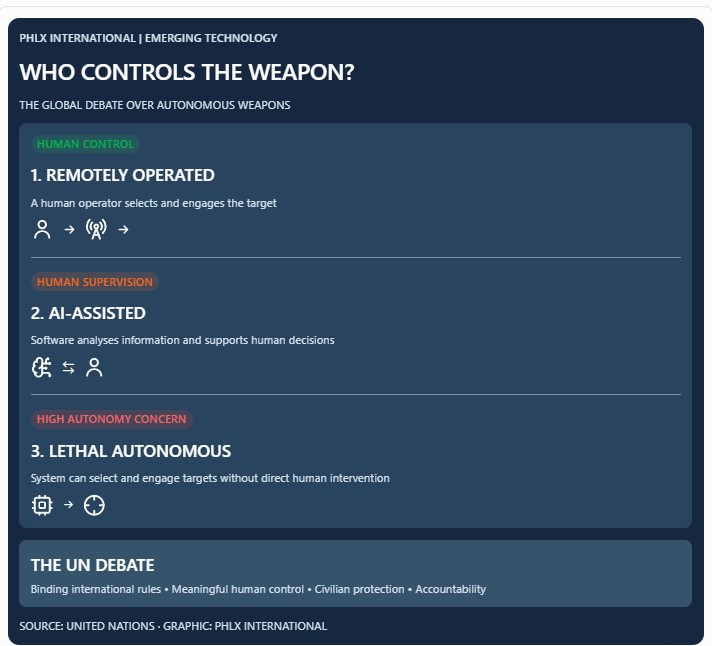
Some systems require human operators to approve attacks, while others may be designed to select and engage targets independently once activated.
The distinction is important because not every weapon that uses artificial intelligence qualifies as a fully autonomous weapon.
The central concern is the possibility that a machine could make decisions about targeting and the use of lethal force without meaningful human intervention.
The United Nations says autonomous weapon systems raise serious legal, ethical, humanitarian and security questions that existing international arrangements have not specifically resolved.
United States Proposes Non-Binding Guidelines
The United States is among the countries opposing the immediate launch of negotiations for a legally binding agreement.
Washington argues that existing international humanitarian law already provides rules governing the conduct of warfare and that additional international restrictions could limit military flexibility.
Instead of a binding treaty, the US favours developing non-binding guidelines governing the development and use of autonomous weapons.
The American delegation has proposed a five-year mandate for further work towards a non-binding agreement.
The approach would allow governments additional time to examine technological developments and establish voluntary principles without immediately committing themselves to new treaty obligations.
However, supporters of stronger regulation argue that voluntary guidelines would not provide sufficient protection against the risks associated with weapons capable of independently selecting and attacking targets.
They maintain that international rules are necessary to establish clear limits on the types of autonomous weapons that can be developed and deployed.
The disagreement reflects wider differences between governments seeking to preserve military flexibility and those prioritising international humanitarian safeguards.
Russia Also Opposes Restrictions on Autonomous Weapons
Russia has also resisted proposals for a legally binding international agreement.
Moscow has argued that negotiations aimed at restricting or prohibiting autonomous weapons are premature and that governments should first address procedural and organisational questions.
Russian officials have expressed concern about how international rules could affect military development and the future use of emerging technologies.
According to Reuters, Russia initially challenged arrangements allowing observers, including representatives of the European Union and non-governmental organisations, to address the conference.
The disagreement added another layer of diplomatic tension to the proceedings.
Russia’s position has raised concerns among humanitarian organisations that discussions could be delayed or weakened before governments reach agreement on the scope of any future restrictions.
The United States and Russia are particularly influential in the debate because both countries possess significant military and technological capabilities.
Their resistance could make it difficult for the conference to reach consensus on a binding international instrument.
Seven Countries Push for a Legally Binding Agreement
Despite opposition from major military powers, several governments are seeking a more ambitious international response.
Austria, Belgium, Brazil, Ireland, Mexico, New Zealand and Panama have submitted a proposal calling for negotiations towards a legally binding agreement on autonomous weapons.
Their initiative reflects growing international concern about the possibility of military systems making independent decisions about human targets.
The countries supporting stronger regulation argue that international law must develop alongside military technology rather than waiting until autonomous weapons become more widely deployed.
They want a framework that establishes clear prohibitions and restrictions, protects civilians and ensures that human beings remain responsible for decisions involving the use of force.
The campaign for binding rules has also received support from a broader group of countries.
The Stop Killer Robots campaign, which advocates international restrictions on autonomous weapons, says approximately 130 countries support the development of international rules.
However, support for regulation does not necessarily mean that all these governments agree on the precise legal form or wording of a future agreement.
The challenge facing negotiators is to translate broad support for safeguards into a text that governments can formally adopt.
European Countries Seek a Possible Compromise
The United Kingdom, Germany and France are supporting an alternative approach that could help bridge the differences between governments.
According to Reuters, the three European countries support negotiations on an international instrument without deciding in advance whether its final form must be legally binding.
This approach could provide governments with an opportunity to negotiate substantive safeguards while leaving the question of legal status open.
It represents a potential compromise between countries demanding a binding protocol and those preferring voluntary guidelines.
The chair of the Geneva discussions has also proposed a two-year mandate for negotiations towards a legally binding protocol.
The American proposal, by contrast, would provide a five-year mandate for work towards a non-binding agreement.
The difference in both duration and legal ambition illustrates the extent of disagreement.
A shorter negotiating period could accelerate the development of international restrictions, while a longer process would give governments additional time to resolve technical and legal questions.
Whether either proposal can attract sufficient support remains uncertain.
Why Autonomous Weapons Are Raising Humanitarian Concerns
The debate over autonomous weapons is not simply about military technology.
It concerns the responsibility of governments and military commanders when machines are given the ability to make decisions that can result in human deaths.
Traditional military operations generally involve human personnel making decisions about identifying targets, evaluating threats and authorising the use of lethal force.
Autonomous weapons could reduce or remove direct human involvement in some of these processes.
This raises questions about how a machine can reliably distinguish combatants from civilians, assess whether a target remains a legitimate military objective and respond appropriately when circumstances change.
Military environments are often unpredictable.
A weapon system operating in a changing environment may encounter unexpected civilian movements, damaged infrastructure, misleading information or situations that differ from those anticipated during its development.
Campaigners warn that systems operating with insufficient human oversight could make fatal errors or respond in ways that their operators cannot adequately predict.
There are also questions about accountability.
If an autonomous weapon kills civilians or attacks an unlawful target, responsibility may involve the individuals who designed, programmed, deployed or authorised the system.
Humanitarian organisations argue that responsibility must remain identifiable and cannot simply be transferred to an algorithm or machine.
These concerns have become central to the international debate over meaningful human control.
UN Secretary-General Calls for Clear Restrictions
United Nations Secretary-General António Guterres has repeatedly called for governments to establish international restrictions on autonomous weapons.
His position is that weapons operating without human judgement and control, and which cannot be used consistently with international humanitarian law, should be prohibited.
Other autonomous weapon systems should be subject to appropriate regulation.
Guterres has argued that decisions about life and death should not be left entirely to machines.
The UN has identified the 2026 CCW Review Conference as an important opportunity for governments to move towards negotiations on a legally binding international instrument.
The Secretary-General has also worked with International Committee of the Red Cross President Mirjana Spoljaric to urge governments to establish clear prohibitions and restrictions.
Their joint position emphasises civilian protection, compliance with international humanitarian law and the importance of maintaining human accountability.
The International Committee of the Red Cross has similarly warned that existing humanitarian law does not adequately address all the specific risks created by autonomous weapons.
It wants governments to agree on rules that preserve human responsibility and prevent unpredictable systems from making uncontrolled decisions about the use of force.
Autonomous and AI-Assisted Weapons Are Already Raising Questions in Conflicts
The international debate has become more urgent because artificial intelligence and increasingly autonomous functions are already appearing in military operations.
Reuters has reported the use of semi-autonomous, AI-assisted weapons in conflicts including Ukraine, Sudan and the Middle East.
Such systems may perform functions such as identifying objects, analysing surveillance information, navigating environments or supporting targeting decisions.
However, the degree of human involvement differs between systems.
A remotely operated drone controlled by a human pilot is not equivalent to a weapon that can independently select and engage targets.
Similarly, using artificial intelligence to assist a military operator does not automatically mean that the weapon is fully autonomous.
The distinction is essential when discussing the international regulation of military AI.
Associated Press has also reported examples of armed drones capable of independently striking targets in limited instances, while noting that widespread deployment of fully autonomous weapons has not yet occurred.
Humanitarian organisations are concerned that waiting until these capabilities become widespread could make international restrictions more difficult to establish.
They argue that governments should agree on safeguards before the technology becomes deeply integrated into military operations.
Existing International Law Does Not Specifically Regulate Autonomous Weapons
One of the central legal questions concerns whether existing international humanitarian law is sufficient to govern autonomous weapons.
The Convention on Certain Conventional Weapons already contains protocols restricting or prohibiting particular categories of weapons considered excessively injurious or indiscriminate.
These include restrictions on incendiary weapons, blinding laser weapons and certain mines and explosive remnants of war.
However, no existing CCW protocol specifically regulates autonomous weapon systems.
The convention provides a framework through which governments can negotiate additional protocols as new weapons-related challenges emerge.
Supporters of a new instrument argue that autonomous weapons require specific international rules addressing their distinctive characteristics.
These could include prohibitions on systems that cannot be used in compliance with international humanitarian law and requirements governing human judgement, oversight and accountability.
Opponents of a new binding agreement argue that existing rules concerning distinction, proportionality and precautions in attack already apply to military operations involving emerging technologies.
The disagreement is therefore not simply about whether humanitarian law applies, but whether additional rules are necessary to address the particular risks associated with autonomous systems.
Consensus Rules Could Block an International Agreement
Another major challenge facing the Geneva conference is the decision-making structure of the Convention on Certain Conventional Weapons.
Decisions under the convention are generally reached through consensus.
This means that a single participating state can prevent agreement on a proposed outcome.
The arrangement makes it difficult for governments to adopt a new international protocol when major military powers disagree over its scope or legal status.
The United States and Russia therefore have significant influence over the negotiations.
Even if a substantial majority of participating countries supports binding restrictions, the consensus requirement could prevent the adoption of an agreement without broader diplomatic support.
This has raised concerns that the conference could conclude without a sufficiently ambitious mandate for future negotiations.
However, diplomats have not ruled out a compromise involving legally binding provisions, non-binding guidelines or a combination of both.
The coming days will be important in determining whether governments can agree on a way forward.
What Happens Next at the Geneva Conference?
The Seventh Review Conference is scheduled to continue until November 20, 2026.
The programme of work for Main Committee II includes consideration of lethal autonomous weapons systems on November 17, followed by work on a final document concerning the issue on November 18 and 19.
Delegations are expected to continue discussing the proposals, the future mandate of the expert group and the possible legal form of an international instrument.
The conference will also consider the wider implications of emerging weapons technologies for international humanitarian law.
As of November 17, no final agreement launching negotiations on a legally binding autonomous weapons treaty has been announced.
The outcome will depend on whether governments can reconcile their differences over the duration, legal status and substance of future negotiations.
For countries seeking stronger restrictions, the priority is to ensure that autonomous weapons cannot operate without appropriate human control and accountability.
For governments opposing a binding agreement, preserving flexibility in military research and development remains a central concern.
The negotiations therefore represent a major test of the international community’s ability to establish rules for rapidly advancing military technology.
As artificial intelligence continues to transform warfare, the decisions made in Geneva could influence how future generations of weapons are developed, deployed and regulated.
The central question remains whether governments will agree that decisions involving human life must retain meaningful human judgement, or allow military technology to advance without sufficiently specific international safeguards.
Community
Comments
Keep discussion respectful and relevant. Comments never affect rewards.
No comments yet. Start a respectful conversation.