

Former Paraguayan President Santiago Peña has been transferred to a military prison following a judicial order prompted by reports that he received preferential treatment while being held in custody over the collapse of Ueno Bank.
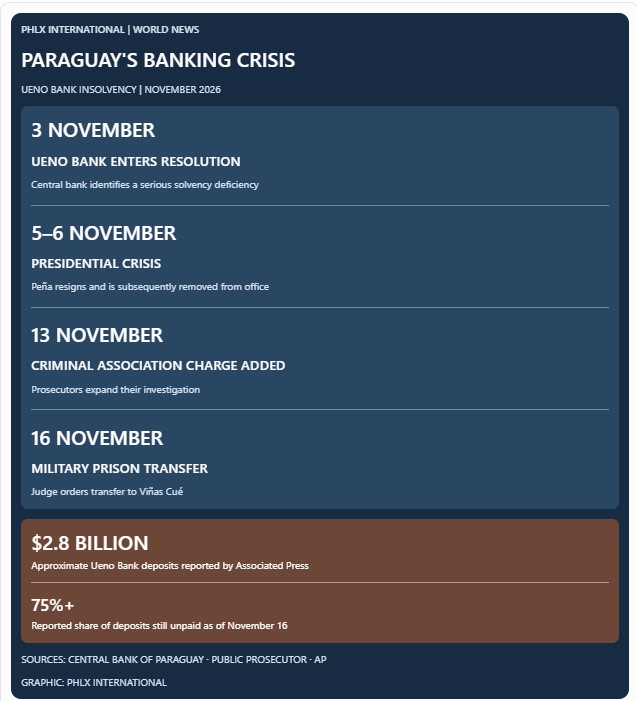
The transfer, ordered on Monday, November 16, by Judge Osmar Legal, moved Peña from the Presidential Escort Regiment, a military installation in the capital, Asunción, to the Viñas Cué military prison.
The decision comes amid an expanding criminal investigation into the financial institution’s insolvency, which has triggered a major political crisis, disrupted millions of customer accounts and resulted in Peña’s removal from office.
Local media reports had raised questions about the conditions under which the former president was being detained, including claims that his accommodation at the Presidential Escort Regiment included a private gym, bathroom and other facilities not available to ordinary detainees.
Following the reports, President Pedro Alliana announced the dismissal of Colonel José David Daiub, commander of the Presidential Escort Regiment, over allegations that Peña had received special treatment.
Alliana, who succeeded Peña after his removal from office earlier in November, also pledged that his administration would provide prosecutors with the resources required to investigate the bank’s collapse.
Peña remains in pretrial detention and has denied the allegations against him. No criminal conviction has been established.
Judge Orders Transfer to Viñas Cué Military Prison
Judge Osmar Legal ordered Peña’s immediate transfer from the Presidential Escort Regiment to the Viñas Cué military prison on November 16.
The order followed public scrutiny of the conditions under which the former president was being held after his arrest.
According to reports by local Paraguayan media, Peña’s previous accommodation included a private bathroom, a well-furnished office, a spacious dining area and access to a gym.
The allegations generated public criticism, particularly as thousands of Ueno Bank customers continued facing difficulties accessing their savings following the financial institution’s collapse.
Under the new judicial arrangement, Peña is to be accommodated separately from other detainees, particularly individuals who are also defendants in the Ueno Bank investigation.
The court also instructed prison authorities to implement appropriate security arrangements to protect his life and physical integrity and to provide information about the procedures governing his detention.
Peña arrived at Viñas Cué on Monday afternoon, where he was registered as an inmate.
The transfer does not represent a conviction or a new criminal sentence. He remains in preventive detention while the criminal proceedings continue.
Ueno Bank’s Insolvency Triggers Paraguay’s Political Crisis
The investigation involving Peña is connected to the collapse of Ueno Bank, a major digital lender whose financial difficulties have affected millions of customers.
On November 3, 2026, the Central Bank of Paraguay announced that it was initiating a formal resolution procedure for the institution after identifying a serious deterioration in its solvency position.
According to the central bank, adjustments made to Ueno’s financial statements during a regulatory review revealed that its solvency ratio had fallen below 50 per cent of the minimum required level.
The regulator said the intervention was intended to address the bank’s financial condition in an orderly manner, protect depositors and preserve confidence in the wider financial system.
The decision effectively restricted access to funds held through the institution and disrupted financial transactions involving households, businesses and public-sector organisations.
Associated Press reported that the bank’s difficulties affected nearly three million customer accounts and more than $850 million in public funds.
Ueno’s total deposits were estimated at approximately $2.8 billion.
By November 16, around $640 million had reportedly been returned to more than 1.8 million depositors, while more than 75 per cent of the bank’s deposits remained unpaid.
The scale of the disruption has made the crisis one of Paraguay’s most significant recent financial and political controversies.
Prosecutors Investigate Alleged Political Connections and Public Funds
The criminal investigation centres on allegations that political and regulatory officials improperly favoured Ueno Bank and failed to take appropriate action despite concerns about its financial condition.
Paraguay’s Public Prosecutor’s Office opened several criminal investigations on November 5 following complaints concerning the supervision of the bank, the placement of public funds in the institution and the conduct of current and former government officials.
The investigation involves Peña, former Central Bank President Carlos Dagoberto Carvallo Spalding and several former banking regulators.
According to the prosecution’s initial allegations, Ueno Bank received substantial deposits from public institutions and pension-related entities between 2023 and 2026.
Investigators are examining whether Peña used his position as president to influence decisions concerning the placement, renewal and continued maintenance of public and pension funds in the bank.
The prosecution is also investigating alleged financial relationships between Peña and the business group associated with Ueno’s parent company, Grupo Vázquez.
In its November 7 filing, the Public Prosecutor’s Office said its investigation was examining alleged irregularities in the placement of public funds, banking supervision and the provision of potentially incomplete or altered information to public authorities.
The prosecutors also requested precautionary measures concerning the assets of individuals under investigation.
These allegations remain subject to judicial examination and have not been established by a criminal conviction.
Criminal Association Charge Added to Peña’s Case
The investigation expanded on November 13 when Paraguay’s prosecutors added an alleged criminal association offence to the charges facing Peña.
The additional allegation was brought against the former president, former Central Bank chief Carlos Carvallo and several other former financial regulators.
According to the Public Prosecutor’s Office, investigators suspect that the individuals formed an organised structure within public institutions to favour interests connected to Grupo Vázquez and Ueno Bank.
The prosecution alleges that officials used their positions and responsibilities to influence regulatory decisions and prevent corrective action concerning the bank.
Investigators are also examining whether technical warnings about lending limits and financial operations involving companies connected to the bank’s ownership group were adequately addressed.
The prosecution has requested further investigative measures, including the examination of financial records, institutional communications and technical reports.
It has also sought cooperation with foreign authorities to identify and preserve assets potentially connected to the alleged financial misconduct.
The criminal association allegation is an additional accusation, not a judicial finding that Peña or the other individuals committed the offence.
Peña denies wrongdoing and maintains that he will cooperate with the legal process.
How the Banking Crisis Ended Peña’s Presidency
The Ueno Bank crisis rapidly developed into a political confrontation that ended Peña’s presidency.
The former president signed a resignation letter on November 5, 2026, as the controversy surrounding the bank intensified.
However, the country’s political institutions proceeded with impeachment proceedings, and the Senate subsequently removed him from office on November 6.
Vice-President Pedro Alliana was sworn in as the country’s new president to complete the remainder of the presidential term, which runs until August 2028.
The transition followed mounting pressure from lawmakers and public criticism over the government’s handling of the banking crisis.
The controversy also affected the leadership of Paraguay’s Central Bank, with former president Carlos Carvallo becoming a central figure in the investigation.
Carvallo, who previously held a leadership position within the Ueno financial group, is being investigated over his subsequent role in financial regulation and supervision.
The former Central Bank chief has also denied wrongdoing.
The political consequences have extended beyond the immediate removal of Peña, with the new administration facing pressure to restore confidence in the banking sector and establish how public money became exposed to the troubled institution.
President Alliana Orders Dismissal of Military Commander
The controversy surrounding Peña’s detention conditions has created another challenge for the new administration.
On November 16, President Alliana announced that he had ordered the removal of Colonel José David Daiub from his position as commander of the Presidential Escort Regiment.
The decision followed allegations that Peña had received special accommodation and facilities while being held at the military installation.
The reports had generated public criticism because of the contrast between the former president’s reported detention conditions and the financial difficulties experienced by ordinary depositors.
Alliana said his government would support the investigation into the collapse of Ueno Bank.
He also pledged that prosecutors would have access to the resources needed to establish what happened and identify those responsible.
The new president’s response is part of a broader effort to demonstrate that his administration will not obstruct investigations into the financial crisis.
However, the effectiveness of the government’s response will ultimately depend on the independence of the investigative process, the recovery of affected funds and the ability of financial regulators to restore public confidence.
Depositors Still Await the Return of Their Savings
The financial consequences of Ueno Bank’s insolvency remain a major concern for Paraguayan households and businesses.
The institution served a substantial portion of the country’s population, and its disruption left millions of customer accounts affected.
The Central Bank of Paraguay introduced an initial deposit-guarantee payment arrangement for eligible customers.
Under the first announced phase, eligible depositors with balances of up to 10 million Paraguayan guaraníes, who had no outstanding debts to the bank and maintained an account with another participating financial institution, were included.
The regulator also said subsequent payments would be communicated through official channels.
However, the statutory deposit-guarantee framework has limits, meaning that the repayment of larger balances depends on the applicable legal procedures and the wider resolution process.
The financial disruption has also affected public institutions.
Paraguay’s Public Prosecutor’s Office said its investigation was examining the placement of government and pension-related resources in Ueno Bank, including deposits made by public-sector entities.
According to information incorporated into the prosecution’s November 7 filing, public and pension-related deposits at the bank had reached approximately 3.61 trillion guaraníes and $233.4 million as of September 2026.
The authorities are therefore investigating not only the circumstances surrounding the bank’s insolvency but also the potential exposure of public resources.
The government faces the difficult task of protecting depositors, preserving financial stability and determining the responsibilities of those involved in the bank’s supervision and operations.
Investigation Extends Beyond the Former President
The Ueno Bank case involves several former financial officials and executives whose activities are being examined by prosecutors.
Among them are former Central Bank president Carlos Carvallo and former banking superintendent Holger Insfrán.
Other former members of the Central Bank’s board have also been included in the investigation.
The prosecution is examining whether regulatory officials failed to respond appropriately to warnings concerning credit exposure and financial transactions involving businesses connected to Ueno’s ownership group.
Separate investigations are also examining the conduct of individuals associated with the bank and its related companies.
Authorities have conducted searches, collected electronic devices and documents and initiated efforts to trace assets potentially connected to the alleged financial misconduct.
The Public Prosecutor’s Office has said the investigation includes international cooperation to identify assets outside Paraguay.
The objective is to establish the circumstances surrounding the institution’s financial difficulties, determine whether public resources were improperly exposed and identify individuals who may bear criminal responsibility.
The investigation remains ongoing, and the allegations against the various individuals must be assessed separately.
A Test for Paraguay’s Financial and Political Institutions
Peña’s transfer to Viñas Cué represents another development in a crisis that has already transformed Paraguay’s political leadership and shaken confidence in its financial system.
The former president’s legal situation is now closely linked to the wider investigation into Ueno Bank, while the new government faces pressure to demonstrate accountability and address the financial difficulties confronting depositors.
The case also raises questions about the relationship between political leadership, financial regulation and the management of public funds.
For Paraguay’s authorities, restoring confidence will require more than the removal of senior officials or the prosecution of individuals accused of wrongdoing.
The government must also ensure that financial institutions are subject to effective supervision, that public funds are properly protected and that depositors receive the payments guaranteed under applicable laws.
For Peña, the immediate challenge is to defend himself against the allegations while remaining in pretrial detention.
For the thousands of households, businesses and public institutions affected by the Ueno Bank crisis, the priority remains the recovery of their money.
As prosecutors continue examining the financial transactions and decisions that preceded the bank’s insolvency, Paraguay faces a crucial test of its ability to establish accountability through independent institutions and restore confidence in its financial system.
Community
Comments
Keep discussion respectful and relevant. Comments never affect rewards.
No comments yet. Start a respectful conversation.