

British Prime Minister Andy Burnham has called for a fundamental reassessment of the United Kingdom’s relationship with the European Union, arguing that the country’s existing Brexit arrangements have damaged its economic prospects and weakened its international standing.
In a major foreign policy speech delivered at the Lord Mayor’s Banquet in London on November 16, Burnham said Britain had lost more than it gained from the way it left the European Union, describing the current post-Brexit settlement as inadequate for the country’s economic and security interests.
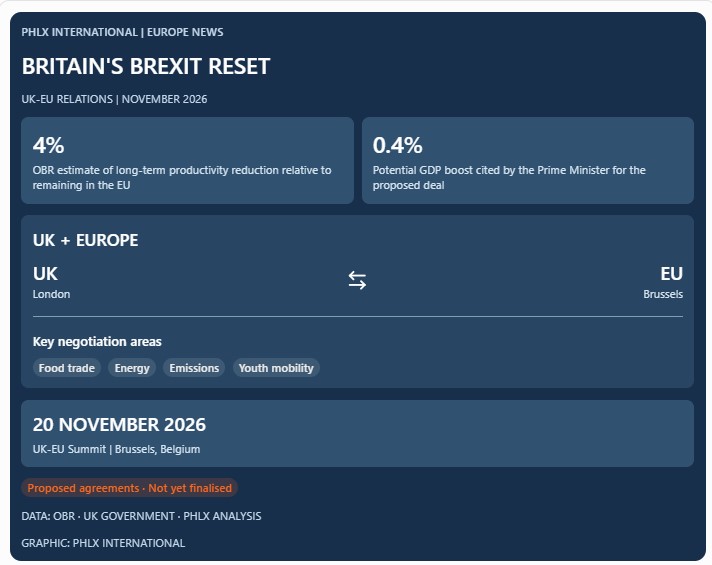
His remarks come ahead of a UK-EU summit scheduled for November 20 in Brussels, where British and European leaders are expected to pursue agreements covering food trade, energy cooperation, emissions trading and opportunities for young people to work and study across borders.
The prime minister said the existing relationship needed to be reconsidered in light of changing international circumstances, including Russia’s invasion of Ukraine, increasing geopolitical tensions and growing economic competition.
However, he stopped short of announcing an immediate plan to reverse Brexit or take Britain back into the European Union.
Instead, Burnham said his government would first pursue practical improvements to existing arrangements before opening a wider discussion with European partners about the UK’s long-term relationship with the bloc.
He also maintained that any agreement must respect the government’s existing political commitments and that the British public would ultimately determine the country’s future direction.
Burnham Says Britain Has Lost More Than It Gained From Brexit
Addressing business leaders, diplomats and political representatives at the Lord Mayor’s Banquet, Burnham argued that Britain’s departure from the European Union had produced a harder settlement than many voters expected when they supported Brexit in the 2016 referendum.
He said the country had experienced a decade of political division and deteriorating relationships with European partners, with consequences extending beyond trade and economic cooperation.
According to the prime minister, the political approach adopted during the Brexit negotiations damaged relationships with neighbouring countries and weakened Britain’s ability to influence developments across Europe.
He argued that the international environment had also changed significantly since 2016.
Russia’s full-scale invasion of Ukraine, growing security challenges and the increasing importance of cooperation among democratic countries have made closer relationships with European allies more important, he said.
Burnham also linked Brexit to a wider international movement towards isolationism and protectionism, arguing that reduced cooperation had made it more difficult for countries to address shared economic and security challenges.
He maintained that Britain could protect its national interests more effectively by strengthening relationships with neighbouring democracies rather than maintaining unnecessary political and economic barriers.
The prime minister described the current Brexit settlement as insufficient for the challenges facing the country and said the government could no longer avoid discussing its consequences.
OBR Estimates Brexit Will Reduce Long-Term Productivity by 4%
Economic performance formed a central part of Burnham’s argument for closer cooperation with the European Union.
The prime minister cited the Office for Budget Responsibility’s assessment that Britain’s post-Brexit trading relationship with the EU would reduce long-term productivity by approximately 4 per cent compared with the economic position the country would have been in had it remained a member of the bloc.
The OBR’s estimate reflects the effects of increased trade barriers and reduced opportunities for businesses to benefit from competition and economic specialisation.
Its assessment is a long-term productivity estimate relative to a remain-in-the-EU counterfactual, rather than a claim that Britain’s GDP has already fallen by 4 per cent solely because of Brexit.
The distinction is important because the economic impact of leaving the EU cannot be measured simply by comparing the UK’s current economic output with its position before the referendum.
Other factors, including the COVID-19 pandemic, the war in Ukraine, energy prices and changes in global trade, have also affected Britain’s economy.
Nevertheless, the OBR has maintained its assessment that the post-Brexit trading relationship will have a lasting negative effect on UK productivity.
Burnham argued that the consequences have been particularly significant for businesses facing additional paperwork, regulatory requirements and border procedures when trading with European markets.
He also pointed to the potential benefits of reducing these barriers for British farmers, food producers, manufacturers and consumers.
The government believes a closer economic relationship with the EU could help improve trade conditions and support economic growth across different regions of the United Kingdom.
Government Sees Potential 0.4% GDP Boost From New EU Agreement
One of the most significant economic claims in Burnham’s speech was his assessment that a proposed agreement with the European Union could add up to 0.4 per cent to Britain’s gross domestic product.
The figure represents a potential economic benefit rather than an achieved increase in national output.
The government believes that reducing trade barriers, improving market access and strengthening cooperation in strategic sectors could help businesses operate more efficiently and increase economic activity.
In an October statement to Parliament, Burnham said the package of proposed agreements could generate the equivalent of more than £10 billion annually for the UK economy by 2040, with the possibility of further benefits.
The proposed agreements are expected to focus on several areas where Brexit created additional administrative and regulatory difficulties.
These include food and agricultural trade, emissions trading, energy cooperation and a youth mobility arrangement.
For businesses involved in exports, particularly those supplying food and agricultural products to European markets, reducing border checks and regulatory duplication could lower operating costs.
The prime minister also argued that closer cooperation could help ease pressure on household budgets by reducing unnecessary costs within supply chains.
However, the actual economic impact will depend on the final terms, the level of regulatory alignment and how quickly businesses can benefit from any new arrangements.
UK-EU Summit Set for November 20 in Brussels
The upcoming summit is expected to become an important test of Burnham’s approach to rebuilding relations with the European Union.
The prime minister is scheduled to meet European Council President António Costa and European Commission President Ursula von der Leyen in Brussels on November 20.
It will be the second UK-EU summit since the country’s departure from the bloc.
The first summit, held in London on May 19, 2025, established a renewed strategic partnership and identified areas where both sides could deepen cooperation.
The November meeting is expected to advance discussions on the practical implementation of those commitments.
According to the British government, the summit will focus on cutting costs for farmers and food businesses, supporting economic growth and improving cooperation on security and migration.
Burnham said the government was determined to secure agreements that would produce tangible benefits for British households and businesses.
He also praised the groundwork undertaken by previous administrations in preparing the negotiations.
The final outcome will depend on whether British and European negotiators can resolve remaining disagreements over regulatory standards, market access and other outstanding issues.
Food and Agricultural Trade Among Main Priorities
One of the most important areas under discussion is the proposed agreement on food and agricultural standards.
Under the existing post-Brexit arrangements, British businesses trading certain agricultural products with the EU face additional requirements involving certification, inspections and regulatory compliance.
The proposed sanitary and phytosanitary agreement would establish closer cooperation on food safety and animal and plant health standards.
The intention is to reduce unnecessary checks and administrative costs while maintaining appropriate standards for consumers and producers.
British farmers and food exporters could benefit from improved access to European markets, particularly businesses dealing with fresh produce, meat, dairy products and other regulated agricultural goods.
The negotiations are also important for European exporters supplying British supermarkets and food manufacturers.
Reuters reported that UK food and drink exports to the EU fell by nearly a third in 2025 compared with 2019, highlighting the difficulties experienced by some businesses following Brexit.
However, the precise causes of changes in export performance involve several economic factors, and the figures should not be interpreted as evidence that Brexit alone explains every decline.
A successful agreement could nevertheless reduce some of the administrative barriers affecting cross-border food trade.
Emissions Trading and Energy Cooperation Also on the Agenda
The proposed UK-EU agreement is also expected to address emissions trading and energy cooperation.
Both sides are considering linking their respective emissions trading systems, which could improve cooperation between carbon markets and reduce complications for businesses operating across the two jurisdictions.
An emissions trading system places a financial cost on greenhouse gas emissions by requiring participating companies to obtain allowances for the pollution they produce.
Linking the systems could help establish more consistent carbon pricing arrangements and reduce the risk of businesses facing unnecessary differences between the two markets.
The proposal is particularly relevant for energy-intensive industries, including steel, manufacturing and other sectors exposed to international competition.
Energy cooperation is another priority.
The UK and EU have been discussing closer participation in electricity-market arrangements, which could improve cross-border energy trading and support the development of interconnected electricity systems.
The government believes improved cooperation could strengthen energy security and help reduce costs over time.
However, negotiations on the precise arrangements remain separate from the broader political discussion about the UK’s long-term relationship with Europe.
Youth Mobility Scheme Could Create New Opportunities
Another important area of negotiation involves a proposed youth experience scheme.
The initiative would allow young people from the United Kingdom and EU member states to live, work or study in each other’s territories for a limited period under agreed conditions.
The proposal is intended to create additional opportunities for education, professional development and cultural exchange without restoring unrestricted freedom of movement.
The British government has emphasised that any scheme would be time-limited and subject to agreed conditions, including limits on participation and restrictions on access to certain public benefits.
The arrangement is also expected to address the difficulties faced by young people who previously benefited from easier movement between Britain and European countries.
Under the proposed system, participants could gain international work experience, undertake temporary employment and pursue educational opportunities.
However, negotiations remain complicated by disagreements over the financial arrangements for European students and other aspects of the scheme.
The final agreement will need to establish the eligibility criteria, duration of participation and administrative requirements.
Burnham Rules Out Immediate Return to the EU’s Single Market and Customs Union
Despite his criticism of Brexit, Burnham has made clear that the government is not proposing an immediate return to the European Union’s single market or customs union.
He said any agreement reached at the November summit must remain consistent with the government’s manifesto and existing political commitments.
The prime minister outlined three tests that any new arrangement must satisfy.
First, it must respect the government’s manifesto and political red lines.
Second, it must improve the existing Brexit settlement and bring it closer to what voters believed they were choosing in 2016.
Third, it must pass what Burnham calls the Makerfield Test, meaning it must produce practical improvements in the everyday lives of people, particularly in communities that have experienced economic neglect.
The government argues that closer cooperation can deliver economic benefits without immediately reversing the central legal and political consequences of Brexit.
However, Burnham also said the country should not avoid a broader discussion about its future relationship with Europe.
After the November summit, his government intends to begin discussions with EU partners about possible long-term arrangements.
The options and the government’s assessment of them would subsequently be presented to inform decisions in the next Parliament.
Burnham said the British public would remain in control of the final direction.
He has therefore opened the possibility of a wider reassessment without announcing an immediate application to rejoin the EU.
Conservative Opposition Warns Against Reopening Brexit Debate
Burnham’s comments have attracted criticism from Conservative politicians, who argue that reopening the Brexit debate could create renewed uncertainty for businesses and investors.
A Conservative Party spokesperson told Sky News that revisiting the political arguments surrounding Britain’s departure from the EU was a mistake.
The party argued that businesses needed stability and clarity rather than another prolonged debate over the country’s constitutional and economic relationship with Europe.
The criticism reflects continuing political divisions over Brexit, which remains one of the most consequential and contested decisions in modern British political history.
Supporters of closer European cooperation argue that the existing arrangements have imposed unnecessary economic costs and reduced Britain’s influence.
Opponents of further integration maintain that leaving the EU gave Britain greater freedom to determine its own regulations, immigration arrangements and trade policies.
The debate also involves questions about national sovereignty and the extent to which Britain should align its laws and standards with those of the European Union.
Burnham has attempted to position his approach as pragmatic, arguing that practical cooperation should be judged by whether it improves economic conditions and national security rather than by ideological positions.
Brexit Debate Extends Beyond Trade and Economic Growth
The prime minister’s speech also placed Britain’s relationship with Europe within a wider foreign policy strategy.
Burnham argued that the international environment has become increasingly challenging, with wars, geopolitical competition and economic protectionism affecting countries across the world.
He said closer cooperation with European allies was important for maintaining security and responding to threats posed by Russia.
The prime minister also emphasised Britain’s commitment to NATO and continued support for Ukraine.
He argued that a stronger relationship with European democracies would improve Britain’s ability to influence international decisions and protect shared interests.
Beyond Europe, Burnham outlined plans to strengthen relationships with Commonwealth countries and expand Britain’s international leadership.
He also highlighted the country’s forthcoming presidencies of the G20 in 2027 and the G7 in 2028.
The speech therefore represents a broader attempt to reposition British foreign policy around international cooperation and economic diplomacy.
What Happens Next?
The immediate focus will be the UK-EU summit in Brussels on November 20.
British and European leaders are expected to assess progress on food trade, emissions trading, energy cooperation and youth mobility.
The outcome will determine whether the two sides can reach practical agreements capable of reducing some of the economic and administrative barriers created by Brexit.
Further negotiations may be required before all proposed arrangements can be finalised and implemented.
After the summit, Burnham intends to open a wider discussion with European partners about Britain’s long-term relationship with the bloc.
The government will eventually present its assessment of the available options to inform decisions in the next Parliament.
For now, there is no announcement of an immediate return to EU membership, the single market or the customs union.
Nevertheless, the prime minister’s speech represents a significant change in the tone of Britain’s European policy.
Almost a decade after the 2016 referendum, the government is increasingly willing to discuss whether the current Brexit settlement is delivering the economic, diplomatic and political outcomes the country expected.
The coming negotiations will provide an early indication of how far Britain and the European Union are prepared to go in rebuilding their relationship.
For businesses, workers and households on both sides of the Channel, the central question will be whether closer cooperation can translate into lower costs, stronger trade and improved economic opportunities without reopening the political divisions that shaped Brexit.
Community
Comments
Keep discussion respectful and relevant. Comments never affect rewards.
No comments yet. Start a respectful conversation.