

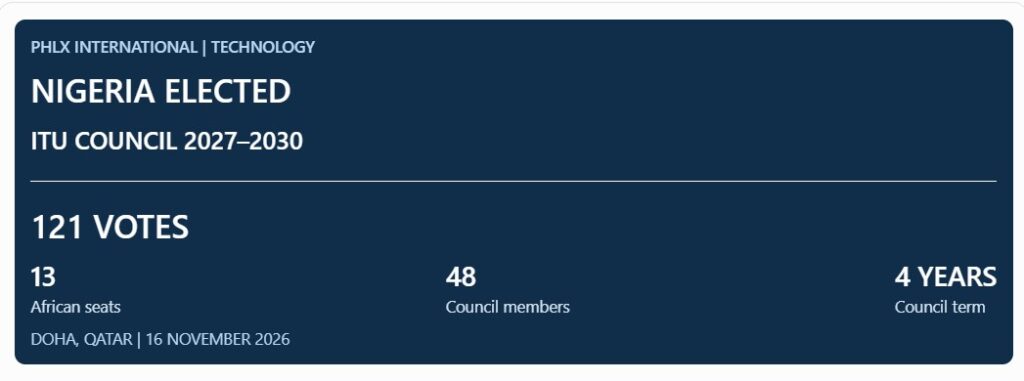
Nigeria has been elected to the Council of the International Telecommunication Union (ITU) for the 2027–2030 term after securing 121 votes in an election held during the United Nations agency’s Plenipotentiary Conference in Doha, Qatar.
The election, conducted on November 16, places Nigeria among 13 African countries selected to serve on the 48-member Council, which oversees the organisation’s activities, policies and strategic direction between sessions of its Plenipotentiary Conference.
The ITU announced the results in an official statement released on Monday, confirming Nigeria’s election alongside other successful candidates from Africa.
The outcome gives Nigeria continued representation in the international institution responsible for coordinating important aspects of global telecommunications, including radio-frequency spectrum, satellite orbits, international technology standards and digital connectivity.
Nigeria Among 13 African Countries Elected
According to the ITU’s official election results, Nigeria secured 121 votes in the African regional contest.
The country was elected alongside Algeria, Côte d’Ivoire, Egypt, Ghana, Kenya, Mauritius, Morocco, Rwanda, Senegal, South Africa, Tanzania and Tunisia.
Africa has 13 allocated positions on the ITU Council, reflecting its regional representation within the organisation’s governance structure.
The election was part of the 2026 ITU Plenipotentiary Conference, which brought together representatives of member states to determine the organisation’s leadership, strategic priorities and financial direction for the next four years.
The official results also showed that Nigeria’s election was part of a wider selection process involving countries from five geographical regions.
The 48 Council positions are distributed as follows:
- Africa: 13 seats.
- Asia and Australasia: 13 seats.
- The Americas: 9 seats.
- Western Europe: 8 seats.
- Eastern Europe and Northern Asia: 5 seats.
The regional arrangement is intended to ensure geographical representation in the governance of the international telecommunications body.
What the ITU Council Does
The International Telecommunication Union is a United Nations specialised agency responsible for coordinating international telecommunications and digital technology cooperation.
Established in 1865, the organisation works with 194 member states and more than 1,000 companies, universities and other organisations.
Its responsibilities include coordinating the international use of radio-frequency spectrum and satellite orbits, developing telecommunications standards and supporting the expansion of digital connectivity.
The ITU Council serves as the organisation’s governing body between sessions of the Plenipotentiary Conference.
Its responsibilities include overseeing ITU activities, policies and strategies, managing working groups and preparing draft strategic and financial plans for consideration at the next Plenipotentiary Conference.
The Council also provides an institutional framework through which member states participate in discussions concerning the organisation’s priorities and implementation of its programmes.
Nigeria’s election therefore gives the country a seat in discussions and decisions concerning the administration and strategic direction of the international telecommunications institution.
Why Nigeria’s Election Matters for the Telecommunications Sector
Nigeria’s membership of the ITU Council provides an opportunity for the country to participate directly in international discussions concerning telecommunications governance and digital development.
Issues considered within the organisation include spectrum management, satellite communications, telecommunications standards, digital infrastructure and universal connectivity.
These areas have implications for countries seeking to expand broadband access, improve telecommunications services and strengthen digital infrastructure.
For Nigeria, participation in the Council provides an institutional channel to contribute to discussions involving international standards and the coordination of telecommunications resources.
The country’s representation may also support engagement with other governments and international technology stakeholders on issues affecting the development of digital services.
However, election to the Council does not automatically guarantee additional telecommunications investment, improved network coverage or changes to Nigeria’s domestic regulatory framework.
Those outcomes would depend on national policies, private-sector investment, regulatory decisions and the practical implementation of international cooperation.
The significance of the election lies primarily in Nigeria’s participation in the governance of an organisation whose decisions and activities influence the global telecommunications environment.
ITU Conference in Doha Completes Major Leadership Elections
Nigeria’s election took place during the ITU Plenipotentiary Conference 2026, known as PP-26, which is being hosted in Doha from November 9 to November 27.
The conference is the organisation’s highest policy-making gathering and takes place every four years.
Member states use the meeting to establish general policies, adopt four-year strategic and financial plans and elect the organisation’s senior leadership, Council members and members of the Radio Regulations Board.
Earlier in the conference, member states re-elected Doreen Bogdan-Martin of the United States as ITU Secretary-General.
Adel Darwish of Bahrain was elected Deputy Secretary-General.
The conference also elected Eric Fournier of France as Director of the Radiocommunication Bureau, re-elected Seizo Onoe of Japan as Director of the Telecommunication Standardization Bureau and elected Nele Leosk of Estonia as Director of the Telecommunication Development Bureau.
The November 16 elections completed the selection of Council members and the Radio Regulations Board for the next four-year cycle.
The Radio Regulations Board is a separate 12-member body within the ITU Radiocommunication Sector. Its responsibilities include approving procedures for applying international radio regulations, considering appeals in disputes and advising relevant radiocommunication conferences.
Nigeria’s election was to the 48-member ITU Council, not the separate Radio Regulations Board.
What the 2027–2030 Term Means for Nigeria
The incoming Council will serve during a period in which telecommunications and digital technologies remain central to international economic and infrastructure development.
Countries are increasingly addressing issues involving broadband access, satellite connectivity, artificial intelligence, telecommunications standards, cybersecurity and the efficient use of limited radio-frequency resources.
The ITU provides a platform for governments to coordinate their approaches to these issues and participate in the development of international frameworks.
Nigeria’s participation in the 2027–2030 Council will allow it to contribute to discussions within this framework alongside other elected member states.
The country’s engagement will be particularly relevant to matters affecting developing economies, including digital inclusion, affordable connectivity and the expansion of telecommunications infrastructure.
Nevertheless, the practical benefits of membership will depend on Nigeria’s participation in Council activities, the positions it advances and its ability to translate international cooperation into domestic telecommunications development.
What Happens Next?
With the election concluded, the incoming Council members will begin their 2027–2030 term under the ITU’s new governance cycle.
The organisation’s Plenipotentiary Conference will continue in Doha until November 27, with discussions covering strategic priorities, financial planning and other important telecommunications issues.
The elected member states are expected to participate in Council meetings and relevant working groups throughout the coming term.
For Nigeria, the immediate development is its successful election to one of Africa’s 13 Council positions.
The outcome maintains the country’s presence within the international institution responsible for coordinating important aspects of global telecommunications governance.
As the next four-year cycle approaches, attention will turn to how Nigeria uses its Council membership to participate in discussions concerning international connectivity, technology standards and the future direction of global digital development.
Community
Comments
Keep discussion respectful and relevant. Comments never affect rewards.
No comments yet. Start a respectful conversation.