

Nepal is calling for greater international financial support for climate-related disasters as negotiators gather at the 31st United Nations Climate Change Conference (COP31) in Antalya, following devastating floods that caused billions of dollars in damage across the Himalayan country.
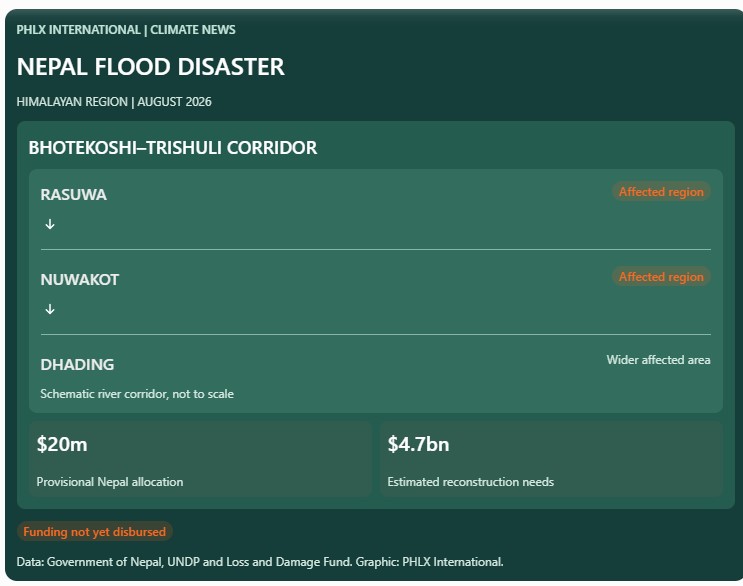
The appeal comes after an August 26 disaster triggered by an ice-and-rock avalanche and subsequent flash flooding along the Bhotekoshi–Trishuli river corridor. The disaster destroyed homes, bridges, roads, power infrastructure and entire settlements, leaving thousands of people dead or missing and many survivors dependent on emergency assistance.
Nepal has received a provisional allocation of approximately $20 million from the United Nations Fund for Responding to Loss and Damage, a financing mechanism established to help vulnerable developing countries recover from climate-related disasters.
However, the amount represents less than one per cent of the approximately $2.5 billion in economic losses reported by the Associated Press. Nepal’s government estimates that the wider reconstruction requirement is approximately $4.7 billion.
The funding has not yet been disbursed. Nepal must complete a project proposal and satisfy the fund’s approval requirements before the money can be released.
At COP31, Nepal is using the disaster to reinforce its demand for predictable, accessible and substantially increased international climate finance, particularly for vulnerable mountain communities.
Nepal Seeks Greater International Support at COP31
Nepal’s delegation has made climate finance and mountain resilience central issues in its participation at COP31.
Foreign Minister Shisir Khanal, who led the delegation during the opening days of the conference, called for greater recognition of the climate risks facing mountain countries.
Addressing the opening plenary on November 9, Khanal highlighted the devastating consequences of recent disasters for Nepal’s population, infrastructure and ecosystems.
He argued that international climate commitments must translate into practical assistance for countries experiencing increasingly severe climate-related impacts.
Nepal has also called for a dedicated work programme on mountains and climate change under the United Nations climate framework.
The proposal seeks to ensure that mountain-specific risks are considered in international climate negotiations, particularly in discussions concerning adaptation, financing and the global response to climate-related losses.
Nepal and Bhutan initially sought a separate formal negotiating agenda item on mountain warming, but the proposal did not make the initial agenda.
Nevertheless, Nepal has continued pushing for mountain-related issues to receive greater attention in the final negotiating discussions.
Khanal said the international response to Nepal’s disaster should move beyond expressions of sympathy.
The government has also called for stronger cooperation in glacier monitoring, early warning systems, scientific research and regional information sharing.
Following Khanal’s departure from Antalya on November 14, Agriculture, Forests and Environment Minister Gita Chaudhary took responsibility for leading Nepal’s delegation through the remaining COP31 negotiations.
August Floods Leave Billions of Dollars in Damage
The disaster began on August 26, when an ice-and-rock avalanche in the high Himalayan region triggered a destructive flow of water, mud and debris along the Bhotekoshi–Trishuli river system.
Communities in Rasuwa, Nuwakot and surrounding districts experienced extensive destruction.
The floods swept away houses, roads, bridges, hydropower infrastructure and other essential facilities.
Entire settlements were damaged or destroyed, leaving residents without reliable access to housing, electricity, transportation and drinking water.
The scale of the human impact was substantial.
Figures published by the United Nations Development Programme, citing Nepal’s National Disaster Risk Reduction and Management Authority, recorded 1,451 deaths and 5,745 missing people as of September 21.
More than 84,000 people were reported affected, while thousands of buildings and more than 100 bridges sustained damage.
In some affected communities, survivors have been living in temporary shelters while relying on donations and humanitarian assistance.
Along the Trishuli River, damaged power infrastructure, vehicles, homes and other facilities remained partially buried in mud months after the disaster.
Broken bridges have also disrupted access between communities and neighbouring towns, complicating relief operations and the restoration of economic activity.
The damage has created a substantial reconstruction challenge for a country with limited financial resources and significant development needs.
$20 Million Loss and Damage Allocation Falls Far Short of Requirements
The United Nations Fund for Responding to Loss and Damage has provisionally set aside $21.6 million following Nepal’s request for emergency assistance.
The decision was taken at an extraordinary meeting of the fund’s board on October 22.
Of the amount provisionally set aside, approximately $20 million is intended to support Nepal, while the remaining $1.6 million relates to associated oversight arrangements.
The allocation followed a request submitted on August 31 by Finance Minister Swarnim Wagle and Agriculture, Forests and Environment Minister Gita Chaudhary.
The decision represented an important step in Nepal’s efforts to secure international assistance for communities affected by the disaster.
However, the allocation remains small compared with the country’s estimated financial requirements.
According to the Associated Press, estimated economic losses from the disaster stand at approximately $2.5 billion.
Nepal’s government has separately put preliminary economic losses and damage at approximately $2.7 billion, while its recovery and reconstruction requirements are estimated at approximately $4.7 billion.
The $20 million allocation therefore represents less than one per cent of the estimated economic losses.
The difference between the provisional allocation and the wider reconstruction requirement illustrates the financing challenges facing Nepal as it attempts to rebuild damaged infrastructure and restore livelihoods.
Nepal Still Waiting for Loss and Damage Funding
Although the Loss and Damage Fund has provisionally set aside money for Nepal, the allocation has not yet translated into cash reaching affected communities.
The government must prepare and submit a detailed project proposal through the fund’s Barbados Implementation Modalities.
The proposal must identify the intended beneficiaries, priority recovery activities and arrangements for implementing the programme.
Nepal has also begun identifying an appropriate organisation to support the implementation process.
According to reporting by Nepal’s OnlineKhabar, officials expected the initial proposal draft to be completed by the second week of December.
The process is intended to ensure that the money is directed towards the communities and sectors most affected by the disaster.
However, the additional requirements have raised concerns about how quickly the funding can become available.
The Associated Press reported that no disbursement date had been announced.
Nepal’s Foreign Minister Shisir Khanal has criticised delays in international disaster financing, arguing that communities facing immediate humanitarian and reconstruction needs should not have to wait months for financial support.
In an interview with Anadolu Agency during COP31, Khanal said delays in delivering climate disaster funding were not justified given the urgency of the situation.
He warned that additional approval requirements could leave affected communities waiting for assistance long after the disaster.
The issue has strengthened Nepal’s demand for simpler funding procedures and more rapid responses from international climate finance institutions.
Loss and Damage Fund Faces Wider Global Financing Shortfall
Nepal’s experience also highlights the financial limitations facing the international Loss and Damage Fund.
The mechanism was established to help vulnerable developing countries address the economic and non-economic consequences of climate-related disasters that cannot be adequately prevented through mitigation or adaptation alone.
However, the fund’s available resources remain substantially below the amount being requested by developing countries.
According to figures reported by the Associated Press, countries have pledged more than $820 million to the fund.
At the same time, the fund faces 176 requests for assistance from developing nations, with combined requests totalling approximately $2.8 billion.
The difference between available commitments and requests raises questions about the fund’s ability to respond quickly and adequately to multiple climate-related emergencies.
The fund’s board is scheduled to meet in December to consider additional requests for support.
For Nepal and other climate-vulnerable countries, the challenge is not only increasing the amount of money committed internationally but also ensuring that the resources are available when disasters occur.
A financing mechanism that takes months to release money may struggle to meet the immediate needs of communities that have lost homes, livelihoods and access to essential services.
The Stockholm Environment Institute has estimated that lower-income countries could require between $400 billion and $1.6 trillion annually in loss and damage financing by 2030.
The estimates underline the scale of the global challenge as climate-related disasters become increasingly costly.
Himalayan Climate Risks Extend Beyond Nepal
Nepal’s demand for greater international assistance also reflects the wider environmental importance of the Himalayan region.
The Hindu Kush Himalaya contains extensive glaciers and snow reserves that feed major river systems across South and Central Asia.
According to the International Centre for Integrated Mountain Development (ICIMOD), nearly two billion people depend on water from rivers originating in the Hindu Kush Himalaya for drinking, agriculture and electricity generation.
The region is particularly vulnerable to rising temperatures, glacier retreat, unstable mountain slopes and the formation of potentially dangerous glacial lakes.
As glaciers retreat and frozen ground thaws, mountain slopes can become less stable, increasing the risk of destructive flows involving water, rocks and debris.
Such events can travel rapidly downstream, leaving communities with limited time to respond.
The risks also extend beyond national borders.
River systems originating in the Himalayas supply water to communities and agricultural regions across several countries.
This makes cooperation in scientific monitoring, disaster preparedness and cross-border early warning systems particularly important.
Climate experts at COP31 have called for better monitoring of unstable slopes and glacial lakes, improved regional data sharing and coordinated warning systems.
For Nepal, these measures are essential not only for rebuilding after the August disaster but also for reducing the potential impact of future emergencies.
Nepal Wants Grant-Based Climate Finance, Not More Debt
Another major issue raised by Nepal at COP31 is the need for climate financing that does not place additional debt burdens on vulnerable countries.
Developing countries have repeatedly argued that international climate assistance should be predictable, accessible and provided substantially through grants rather than loans.
Nepal has emphasised that countries with limited historical contributions to global greenhouse gas emissions should not be forced to finance the consequences of increasingly severe climate disasters through additional borrowing.
The government’s position is that international support should help affected countries restore essential infrastructure, protect livelihoods and strengthen resilience without worsening existing debt pressures.
This concern is particularly relevant for countries facing multiple development challenges, including poverty reduction, infrastructure investment, food security and limited public resources.
Nepal has also called for international support to strengthen its ability to monitor glaciers, improve disaster forecasting and develop resilient infrastructure.
The country argues that climate finance should cover both immediate recovery requirements and longer-term measures designed to prevent future disasters from causing similar levels of destruction.
What Happens Next?
Attention will now focus on Nepal’s efforts to complete the project proposal required to access the provisional $20 million allocation.
The government must identify priority projects, finalise implementation arrangements and satisfy the Loss and Damage Fund’s approval requirements before the money can be released.
The expected preparation of the initial proposal in December will be an important milestone.
The fund’s December board meeting could also provide an opportunity for further consideration of financing requests from developing countries.
Meanwhile, Nepal’s delegation at COP31 will continue pressing for stronger international recognition of mountain climate risks, accessible financing and more effective loss and damage arrangements.
The country’s demands are part of a wider debate over whether international climate commitments are translating into practical support for the communities most exposed to climate-related disasters.
For the survivors of the August floods, the immediate priorities remain restoring homes, reconnecting communities, rebuilding infrastructure and recovering lost livelihoods.
The $20 million provisional allocation represents an important beginning, but it remains a small contribution towards the estimated billions of dollars needed to rebuild.
Nepal’s experience is therefore likely to remain an important example in the wider COP31 debate over climate justice, international responsibility and the need to make disaster financing faster, more predictable and accessible to vulnerable countries.
Community
Comments
Keep discussion respectful and relevant. Comments never affect rewards.
No comments yet. Start a respectful conversation.