

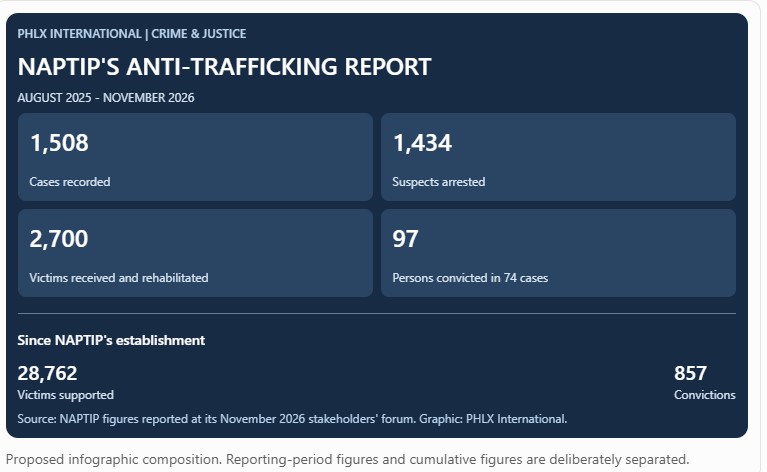
The National Agency for the Prohibition of Trafficking in Persons (NAPTIP) has recorded 1,508 cases of human trafficking and related offences, arrested 1,434 suspects and received and rehabilitated 2,700 victims between August 2025 and November 2026.
The figures were disclosed by the agency’s Director-General, Binta Adamu Bello, at the 29th National Stakeholders’ Consultative Forum on Human Trafficking in Nigeria and the 3rd Policy-Level Meeting in Abuja.
The agency also reported that 65 cases involving 85 accused persons were initiated in court during the reporting period, while 74 cases resulted in the conviction of 97 offenders.
The figures highlight the scale of NAPTIP’s reported enforcement and victim-support activities, as well as the continuing challenges involved in investigating and prosecuting human trafficking offences.
NAPTIP Reports 1,434 Arrests in 15-Month Period
Presenting the agency’s performance figures, Bello said NAPTIP recorded 1,508 cases of human trafficking and related offences from August 2025 to November 2026.
The agency reported 1,434 arrests during the period, comprising 52 per cent males and 48 per cent females.
The figures cover cases handled by the agency and related offences. They should not be interpreted as a count of convicted traffickers, since an arrest does not establish guilt.
The difference between reported cases and arrests also does not necessarily mean that every case resulted in an arrest or that every arrested suspect was connected to a separate case.
The statistics were presented as part of the agency’s account of its operational activities and efforts to strengthen investigations, enforcement and prosecution.
2,700 Victims Received and Rehabilitated
Beyond arrests and investigations, NAPTIP reported that it received and rehabilitated 2,700 victims during the same reporting period.
The agency’s breakdown showed that females accounted for 72 per cent of the victims, while males represented 28 per cent.
Children constituted 48 per cent of those received and rehabilitated, compared with 52 per cent who were adults.
The figures highlight the importance of victim protection alongside law enforcement.
Human trafficking responses require more than the identification and arrest of suspected offenders. Victims may also require assistance to recover from exploitation, access appropriate support services and rebuild their lives.
NAPTIP said it had strengthened its victim-centred interventions through psychosocial counselling, vocational training, family tracing and reunification, legal assistance and economic empowerment.
These interventions are intended to support victims beyond their initial rescue and provide assistance towards rehabilitation and reintegration.
The reported figures also underline the need for continued attention to children and other vulnerable people who may be exposed to trafficking and exploitation.
Agency Reports 74 Convictions Involving 97 Offenders
NAPTIP also provided an update on its prosecution activities.
According to Bello, the agency initiated 65 cases involving 85 accused persons in court during the reporting period.
Separately, 74 cases resulted in the conviction of 97 offenders for human trafficking offences.
However, the two figures should not be treated as a direct comparison between cases newly initiated and cases concluded within the same reporting period.
Bello clarified that the convictions included some cases instituted before the previous stakeholders’ forum in 2025 but concluded afterwards.
This distinction is important when assessing the agency’s prosecution performance.
Court proceedings can extend beyond the period in which an investigation begins or charges are filed. Consequently, convictions recorded during a reporting period may arise from cases initiated earlier.
The agency’s cumulative figures provide another indication of its longer-term prosecution record.
Since its establishment, NAPTIP said it had rescued and supported 28,762 victims and secured 857 convictions against human trafficking offenders.
Technology-Facilitated Trafficking and Online Recruitment Under Scrutiny
Another area highlighted by the agency is the increasing use of digital platforms and technology in human trafficking operations.
Bello said NAPTIP had intensified intelligence gathering and surveillance to identify and disrupt trafficking networks operating both physically and online.
Particular attention is being given to technology-facilitated trafficking, deceptive online recruitment and other emerging forms of exploitation.
Online recruitment schemes can expose unsuspecting people to exploitation when individuals are deceived through fraudulent employment opportunities or misleading offers.
The Federal Government has also called for stronger cooperation among law enforcement agencies, technology companies, telecommunications operators and financial institutions to address these threats.
At the stakeholders’ forum, Attorney-General of the Federation and Minister of Justice, Lateef Fagbemi, represented by the Acting Director of the Citizens Rights Department, Kabiru Haliru, emphasised the importance of intelligence sharing, stronger institutional cooperation and adequate resources.
The government also reaffirmed its commitment to improving institutional support and funding for NAPTIP and other organisations involved in combating human trafficking.
Delta State Seeks Greater NAPTIP Presence
The agency’s nationwide operational coverage was another issue raised during the forum.
Bello called for the establishment of a NAPTIP state command in Delta State, identifying it as the only state without an agency command at the time of her statement.
The appeal followed the establishment of a new NAPTIP command in Kogi State.
According to the Director-General, the absence of a dedicated command in Delta has increased operational costs for the Benin Zonal Command, which oversees the state.
She also warned that the arrangement could delay emergency responses and affect the agency’s ability to provide timely protection and assistance to victims.
Bello appealed to the Delta State Government to facilitate the establishment of a command in Asaba.
A stronger operational presence at the state level could improve the agency’s ability to receive reports, coordinate investigations and respond to trafficking incidents.
The issue also highlights the importance of cooperation between federal institutions and state governments in addressing trafficking.
Government Urges States to Strengthen Anti-Trafficking Efforts
Speaking at the forum, Fagbemi urged state governments to take greater responsibility for preventing human trafficking and supporting victims.
He maintained that the fight against trafficking should not be left to the Federal Government alone.
The Attorney-General called on states to strengthen their anti-trafficking task forces, improve coordination among relevant institutions and incorporate anti-trafficking programmes into their budgets.
He also emphasised the importance of addressing the vulnerabilities that trafficking networks exploit, including poverty, limited economic opportunities and inadequate access to social protection.
The forum brought together representatives of organisations including the United Nations Office on Drugs and Crime (UNODC), International Organization for Migration (IOM), International Centre for Migration Policy Development (ICMPD), FIAP and the Network Against Child Trafficking, Abuse and Labour (NACTAL).
Their participation reflected the importance of cooperation between government institutions, international organisations and civil society groups in tackling human trafficking.
Nigeria Reviews National Anti-Trafficking Action Plan
The discussions also formed part of broader efforts to assess Nigeria’s National Action Plan on Human Trafficking for 2022–2026.
The existing framework is due to conclude in December 2026, making the review important for identifying achievements, implementation gaps and priorities for the next phase.
According to the Federal Government, the proposed successor framework will cover 2027–2031.
Fagbemi called for an evidence-based review supported by accurate institutional reports, measurable targets, clearly assigned responsibilities and effective monitoring arrangements.
The proposed framework is expected to provide direction for future prevention, investigation, prosecution and victim-protection efforts.
Adequate funding and accountability will also be important to ensure that the commitments made under the framework translate into practical interventions.
What NAPTIP’s Latest Figures Mean
NAPTIP’s reported figures provide an update on the agency’s enforcement and victim-support activities over approximately 15 months.
The 1,508 recorded cases, 1,434 arrests and 2,700 victims received and rehabilitated represent different aspects of the agency’s work and should be considered separately.
The 65 cases initiated in court and 74 cases resulting in convictions also reflect different stages of the judicial process, particularly because some convictions arose from cases filed before the previous stakeholders’ forum.
While the figures demonstrate the agency’s reported operational activities, they do not establish the total prevalence of human trafficking across Nigeria.
The effectiveness of the country’s response will also depend on prevention, early identification, successful prosecution, victim protection and cooperation across all levels of government.
For NAPTIP, the next phase will involve strengthening its operational presence, responding to technology-enabled exploitation and improving the support available to people affected by trafficking.
As Nigeria prepares to develop its next National Action Plan for 2027–2031, attention will turn to how the government and its partners translate the reported progress into stronger protection for vulnerable people and more effective action against trafficking networks.
Community
Comments
Keep discussion respectful and relevant. Comments never affect rewards.
No comments yet. Start a respectful conversation.