

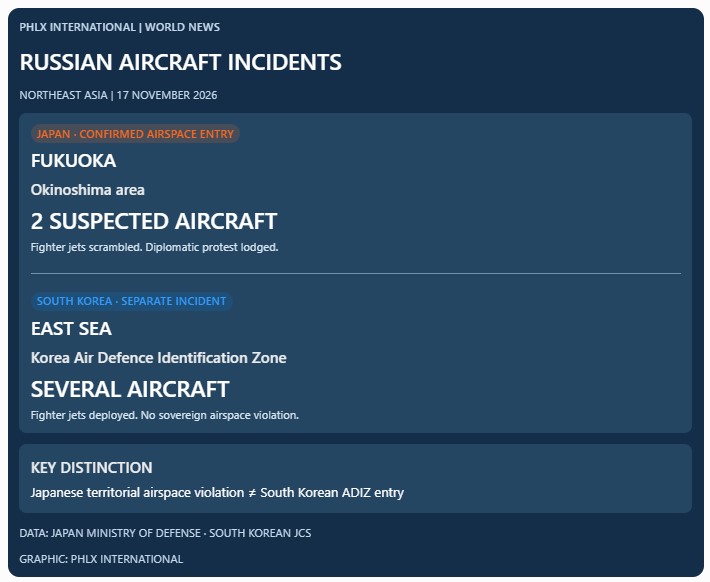
Japan has lodged a strong diplomatic protest with Russia after two suspected Russian military aircraft entered its territorial airspace near Fukuoka Prefecture in southwestern Japan, prompting the country’s Air Self-Defense Force to scramble fighter jets and issue warnings.
The incident occurred early on Tuesday, November 17, near Okinoshima, an island off the coast of Fukuoka, according to Japan’s Ministry of Defense.
Japanese authorities said the first aircraft entered the country’s airspace at approximately 4:07am and remained there until around 4:10am. A second aircraft entered at approximately 4:09am and exited around 4:12am.
The two separate incursions overlapped, with the overall episode lasting approximately five minutes, according to Japan’s Defense Minister Shinjiro Koizumi.
Japan’s government described the incident as a serious violation of its sovereignty and a threat to national security.
Tokyo subsequently lodged what Koizumi described as an extremely stern protest with Moscow through diplomatic channels, demanding measures to prevent a recurrence.
The aircraft continued their journey through the Tsushima Strait before heading south towards the waters between Japan’s westernmost island of Yonaguni and Taiwan, eventually reaching the Pacific Ocean.
The incident has added to concerns about Russian military activity around Japan at a time when relations between the two countries remain strained.
Japan Scrambles Fighter Jets After Airspace Violation
Japan’s Ministry of Defense confirmed that two separate suspected Russian aircraft entered the country’s territorial airspace northwest of Okinoshima in Fukuoka Prefecture.
The Japan Air Self-Defense Force responded by scrambling fighter aircraft from its Western Air Defense Force.
The Japanese fighters issued warnings to the suspected Russian aircraft and took other measures to respond to the incursions.
The Defence Ministry’s announcement provided a detailed timeline of the two entries.
The first aircraft entered at approximately 4:07am and exited at 4:10am, while the second entered at approximately 4:09am and left at 4:12am.
Although the ministry identified both aircraft as suspected Russian planes, it did not disclose their specific types or models.
Japanese authorities also released a map illustrating the reported flight movements, showing the aircraft travelling through the Tsushima Strait and subsequently towards the waters between Yonaguni Island and Taiwan.
The aircraft eventually continued into the Pacific Ocean.
The Ministry of Defense said the Self-Defense Forces responded through emergency fighter deployments and warnings to the aircraft.
The precise purpose of the flight has not been established publicly.
Tokyo Lodges Strong Protest With Moscow
Japan’s Defence Minister Shinjiro Koizumi said the government had delivered an extremely stern protest to Russia following the incident.
He described the entry into Japanese airspace as a serious infringement of national sovereignty and a threat to the country’s security.
Tokyo also demanded that Moscow take measures to prevent similar incidents from happening again.
The protest represents a significant diplomatic response because Japan considers the protection of its territorial airspace a fundamental national security responsibility.
Japan maintains air surveillance and defence systems around its territory, with the Air Self-Defense Force responsible for responding to unidentified or potentially hostile aircraft approaching or entering its airspace.
The fighter deployment on Tuesday demonstrated the military’s response procedures when suspected foreign military aircraft enter Japanese territory.
However, the Japanese government has not publicly established why the suspected Russian aircraft entered the airspace or whether their movements were deliberately intended to challenge Japanese sovereignty.
The aircraft’s exact types and the full operational circumstances also remain undisclosed.
Russia’s explanation for the flight was not included in the reporting available at the time of publication.
South Korea Also Reports Russian Aircraft in Its Air Defence Zone
The Japanese incident came alongside a separate report from South Korea concerning Russian military aircraft operating inside its air defence identification zone.
South Korea’s Joint Chiefs of Staff said several Russian military aircraft briefly entered the Korea Air Defence Identification Zone (KADIZ) early on November 17.
The South Korean military detected the aircraft before they entered the designated zone and deployed fighter jets in preparation for possible contingencies.
The aircraft subsequently left the zone without violating South Korea’s sovereign airspace.
South Korean authorities did not disclose the exact number or types of aircraft involved.
The military said it had taken tactical measures to prepare for possible contingencies while monitoring the aircraft’s movements.
The incident attracted attention because it occurred during the same period as Japan’s reported airspace violation.
However, there is no confirmed evidence establishing that the aircraft involved in the Japanese and South Korean incidents were the same planes or that the movements formed part of a coordinated operation.
The two governments have reported separate security incidents involving Russian military aircraft.
Why South Korea’s Air Defence Zone Is Different From Japanese Territorial Airspace
An important distinction exists between the two incidents.
Japan reported that suspected Russian aircraft entered its territorial airspace, which constitutes a violation of its national sovereignty.
South Korea, by contrast, reported that Russian aircraft entered its air defence identification zone without entering its sovereign airspace.
An air defence identification zone is an area established by a country to identify and monitor aircraft approaching its territory.
It allows military authorities to detect potentially sensitive aircraft movements and take precautionary measures before aircraft reach national airspace.
However, an air defence identification zone is not the same as a country’s territorial airspace and does not automatically mean that an aircraft entering it has violated national sovereignty.
South Korea’s military said the Russian aircraft entered and exited KADIZ without crossing into its territorial airspace.
Russia has also historically disputed South Korea’s authority to impose identification requirements within the zone, arguing that it lacks a basis in international law.
The distinction is important because describing both incidents as airspace violations would misrepresent what the two governments actually reported.
Japan-Russia Relations Already Under Pressure
The latest incident comes amid worsening relations between Japan and Russia.
The two countries have maintained a longstanding territorial dispute over the Kuril Islands, which Russia controls and Japan also claims.
The dispute has prevented the countries from formally concluding a peace treaty ending the state of hostilities dating from the Second World War.
Tensions increased in August after Russian President Vladimir Putin visited Iturup, one of the islands claimed by Japan.
Tokyo objected to the visit, viewing it as another indication of Moscow’s position on the disputed territory.
Relations deteriorated further following the detention of a Japanese journalist in Russia in October on suspicion of espionage.
Japan has repeatedly protested and called for the journalist’s release.
Another source of friction emerged earlier in November when Russia placed several subsidiaries of Japan Tobacco under the temporary management of a Russian company following a presidential order.
Japan protested the move and demanded that it be withdrawn.
These developments have contributed to a broader deterioration in relations between the two countries.
Japan has also expressed concern about increasing military cooperation between Russia and China and their joint military activities around Japanese coastal areas.
The latest airspace incident is therefore taking place against a background of wider diplomatic and security disagreements.
Previous Russian Airspace Incidents Raise Security Concerns
The November 17 incident is not the first time Russian military aircraft have entered Japanese airspace.
According to Japanese reporting, the latest incident represents the first Russian aircraft airspace violation since September 2024.
That earlier incident involved a Russian patrol aircraft that entered Japanese airspace near the country’s southwestern islands.
Japan responded by scrambling fighter jets and issuing warnings.
The recurrence of such incidents has increased the importance of Japan’s air surveillance and rapid-response capabilities.
Japanese authorities regularly monitor military aircraft operating around the country’s northern, western and southern approaches.
The country has a particularly sensitive strategic position because it is located near Russia, China and the Korean Peninsula.
Its surrounding waters also contain important maritime and air corridors connecting Northeast Asia with the wider Pacific region.
Any unexpected movement by foreign military aircraft near Japanese territory can therefore become a significant security concern, especially when diplomatic relations with the country of origin are already strained.
Russian and Chinese Military Activity in Northeast Asia
The latest incidents have also renewed attention on the broader military environment in Northeast Asia.
Russia and China have conducted joint military activities in the region, including aerial patrols that have brought their aircraft into air defence identification zones monitored by Japan and South Korea.
In June 2026, Chinese and Russian military aircraft participated in joint aerial activities over waters surrounding the Korean Peninsula and Japan.
South Korea and Japan have previously responded to such movements by deploying fighter jets and raising diplomatic objections.
The two countries have expressed concerns that increased military activity by neighbouring powers could create additional risks for regional security.
For Japan, the issue is particularly sensitive because its airspace and surrounding maritime approaches are close to several major military powers.
For South Korea, monitoring aircraft movements over the East Sea, also known as the Sea of Japan, is an important part of its national defence arrangements.
However, entering an air defence identification zone should not automatically be treated as evidence of hostile intent.
Military aircraft can conduct surveillance, patrols and other operations in international airspace without necessarily violating another country’s sovereignty.
The circumstances, flight paths and responses of the countries involved are therefore important when assessing individual incidents.
What Happens Next?
Japan is expected to continue monitoring Russian military activity around its territory while pursuing diplomatic channels to address the latest airspace violation.
The government has demanded that Russia take preventive measures to ensure that similar incidents do not happen again.
The Japanese Self-Defense Forces will also continue monitoring the country’s airspace and responding to potentially sensitive aircraft movements.
South Korea’s military is maintaining surveillance of the Korea Air Defense Identification Zone following its separate encounter with Russian aircraft.
For both countries, the incidents highlight the importance of maintaining military readiness and communication mechanisms to reduce the risk of unintended escalation.
The Japanese government has not announced any immediate military retaliation, and the response so far has centred on fighter deployments, warnings and diplomatic protest.
Whether Moscow provides an explanation or takes measures in response to Tokyo’s protest remains an important question.
For now, the November 17 incident represents a fresh challenge to Japan-Russia relations and adds to growing security concerns across Northeast Asia.
While the Japanese airspace violation and South Korea’s separate air defence zone incident have raised regional tensions, investigators and defence authorities have not established that the aircraft movements were coordinated.
The immediate focus remains on Japan’s demand for an explanation and assurances from Moscow that its territorial airspace will not be violated again.
Community
Comments
Keep discussion respectful and relevant. Comments never affect rewards.
No comments yet. Start a respectful conversation.