

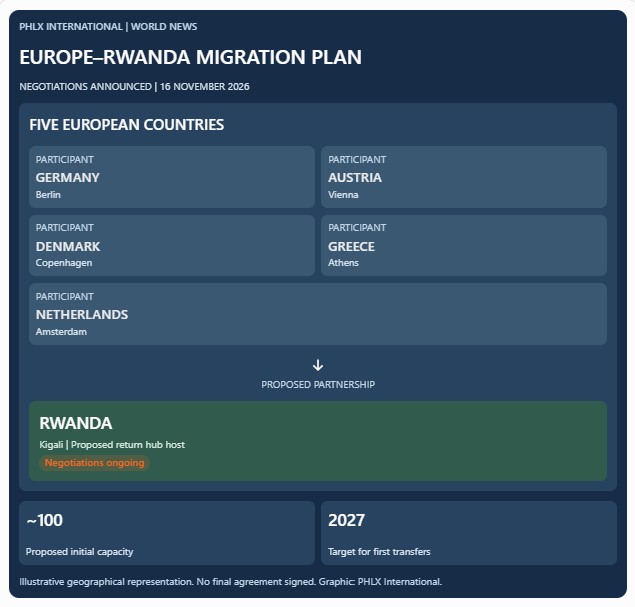
Five European countries have begun negotiations with Rwanda to establish a migrant return centre outside the European Union, in a proposed arrangement that could see people whose asylum applications have been rejected transferred to the East African country from 2027.
Austria, Denmark, Germany, Greece and the Netherlands announced the initiative on November 16 following discussions with Rwandan officials in Vienna.
The proposed facility, described by the participating governments as a return hub, would accommodate people who no longer have a legal right to remain in the participating European countries and whose return to their countries of origin cannot be completed within a reasonable period.
The initiative forms part of a wider European effort to increase the enforcement of immigration decisions and establish additional arrangements for returning people who do not qualify for international protection.
Although negotiations have formally started, a final agreement has not been signed. Governments are aiming to complete the necessary arrangements and begin the first transfers in 2027.
The initial facility is expected to accommodate approximately 100 people at a time, although its eventual capacity and operating arrangements remain subject to further negotiations.
The proposal has generated significant debate over migration management, international legal responsibilities and the protection of migrants transferred to countries with which they may have no previous connection.
Five European Governments Begin Negotiations with Rwanda
The five participating governments confirmed their intention to work with Rwanda during a meeting in Vienna on November 16.
The discussions involved Austrian Chancellor Christian Stocker, Danish Prime Minister Mette Frederiksen, German Interior Minister Alexander Dobrindt, Greek Minister for Migration and Asylum Thanos Plevris, Dutch representatives and Rwanda’s Interior Minister Vincent Biruta.
The governments described the initiative as a partnership intended to improve the implementation of return decisions and provide another option for dealing with people who cannot be returned directly to their countries of origin.
The arrangement is being developed under the European Union’s new Return Regulation, which allows member states to establish return hubs in countries outside the EU.
Under the proposed framework, people transferred to Rwanda would be offered an opportunity to establish a new life there rather than remain indefinitely in European immigration systems.
The five governments argue that the initiative could strengthen cooperation with countries outside Europe, reduce the number of people remaining in the EU without legal permission and discourage irregular migration.
Rwanda has agreed to participate in negotiations over the proposed arrangement and has described the partnership as an opportunity to contribute to international migration management.
However, the detailed agreement covering the centre’s location, accommodation, responsibilities and implementation procedures has not yet been finalised.
Who Could Be Transferred to Rwanda?
The proposed return hub is intended for people who no longer have a legal right to remain in one of the five participating European countries.
Under the governments’ published background paper, the target group consists of migrants subject to enforceable return or removal decisions whose return to their countries of origin is not feasible within a reasonable period.
This could include people whose home governments are not cooperating with repatriation arrangements or individuals who are not cooperating with procedures to establish their identities.
The initiative is not designed to transfer people whose asylum claims are still being considered.
Participating countries have stated that the relevant asylum and immigration procedures must first be completed in Europe, in accordance with national and EU legislation.
People transferred under the arrangement must therefore have exhausted the applicable legal processes and have no remaining right to international protection or residence in the participating countries.
Unaccompanied minors are excluded under the EU Return Regulation.
The governments have also stated that vulnerable individuals must receive additional consideration before any transfer decision is made.
The Dutch government has indicated that the initial phase will focus on single men, although the specific selection criteria will be determined by the participating countries.
What Happens to Migrants After Arrival in Rwanda?
According to the proposed framework, people transferred to Rwanda would initially be accommodated in an open, temporary reception facility.
They would receive residence permits and access to basic services while arrangements are made for their longer-term accommodation.
The governments say the initial reception period would be followed by relocation to appropriate community accommodation.
The proposed support package includes vocational training, assistance with local integration and access to employment opportunities.
People transferred to Rwanda would also have the opportunity to establish permanent lives in the country.
The arrangement would allow them to seek voluntary return to their countries of origin or travel to another country where they have a legal right to enter and reside.
The participating governments have described the arrangement as an alternative to prolonged uncertainty for people who cannot be returned directly to their home countries.
However, several operational questions remain unresolved, including the duration of the initial accommodation period, the exact location of the facility and the practical arrangements for people who do not wish to settle in Rwanda.
Although officials have described the centre as open, the precise conditions governing freedom of movement and long-term residence will need to be established in the final agreement.
Five European Countries to Cover the Costs
The proposed arrangement is expected to be financed primarily by the participating European governments.
According to the published background paper, the five countries will cover the direct operating costs of the return hub, including temporary accommodation and related arrangements.
They will also finance integration and migrant welfare programmes, with the intention of supporting projects that could benefit local communities in Rwanda.
The governments describe the initiative as a mutually beneficial partnership that extends beyond migration management.
For Rwanda, participation could bring additional international cooperation, development-related investment and opportunities to expand its experience in hosting displaced populations.
The country already works with international organisations on programmes supporting refugees and asylum seekers.
Since 2019, Rwanda has participated in the African Union-UNHCR Emergency Transit Mechanism, which has provided protection and assistance to refugees evacuated from dangerous conditions in Libya.
According to the governments’ background paper, 3,274 people had received support through the programme, while 2,685 had subsequently been resettled in third countries.
European governments have cited this experience as part of the justification for considering Rwanda as a partner.
However, the financial details, including the precise allocation of operating costs and development-related support, remain subject to negotiations.
New EU Migration Rules Provide the Legal Framework
The proposed arrangement is linked to the European Union’s new Return Regulation, adopted by the Council of the EU on October 1, 2026.
The regulation creates a framework for establishing return hubs in countries outside the European Union for people who have no legal right to remain in member states.
It allows participating countries to conclude agreements or arrangements with third countries that meet international human rights requirements.
The regulation also requires compliance with international legal principles, including non-refoulement, which prohibits transferring individuals to places where they face a real risk of persecution, torture or other serious harm.
Unaccompanied minors are excluded from these arrangements.
The legal framework also requires agreements to establish procedures for returns, conditions governing people’s stay in the receiving country and the consequences of failing to comply with the arrangement.
Where applicable, independent monitoring mechanisms must also be established.
For the Rwanda initiative, these requirements will form an important part of the negotiations.
The final agreement will need to establish how responsibilities are divided between the European governments and Rwanda, particularly regarding the treatment, legal protection and future status of transferred individuals.
Human Rights Organisations Challenge the Proposal
The proposed arrangement has attracted criticism from human rights organisations, refugee advocates and European civil society groups.
Human Rights Watch said the plan raised serious concerns about Rwanda’s human rights record and questioned whether the proposed arrangement would meet the requirements of European law.
The organisation argued that the participating governments had not publicly provided a sufficiently detailed human rights assessment of Rwanda’s suitability as a receiving country.
It also raised concerns about the potential treatment of vulnerable migrants and the responsibility of European governments after people are transferred outside the EU.
A coalition of 47 humanitarian, human rights and civil society organisations from 15 countries also opposed the initiative.
In a joint statement published on November 16, the organisations warned that transferring people to countries with which they have no meaningful connection could expose them to additional protection risks.
They argued that transferring responsibility outside Europe could make it more difficult to monitor the treatment of migrants and hold participating governments accountable.
The Parliamentary Assembly of the Council of Europe also called on the five governments not to pursue the proposed arrangement.
Its representatives questioned the legal and humanitarian implications of transferring people to Rwanda when they might have no family, social or other meaningful connection to the country.
These concerns are expected to remain central to the negotiations as the participating governments work towards a final agreement.
UNHCR Offers Advice on Refugee Protection and Legal Safeguards
The United Nations High Commissioner for Refugees (UNHCR) has also become involved in discussions surrounding the proposal.
UN High Commissioner for Refugees Barham Salih participated in the November 16 meeting in Vienna with representatives of the five European governments and Rwanda.
UNHCR said its engagement focused on maintaining the integrity of asylum systems, ensuring compliance with international refugee and human rights law and strengthening international responsibility-sharing.
The agency stressed that asylum procedures must be fair, efficient and credible before decisions are made to return people who do not qualify for international protection.
It also highlighted the importance of humane return arrangements and continued support for refugees and countries hosting displaced populations.
UNHCR agreed to make its advisory services available to help ensure that any eventual arrangement complies with applicable international standards.
The agency’s participation does not amount to approval of the proposed centre. Its stated role is to provide advice on refugee protection and legal compliance.
The International Organization for Migration has also indicated its willingness to provide technical assistance and support, subject to appropriate safeguards and arrangements.
Rwanda Defends Its Role as a Migration Partner
Rwanda has defended its participation, presenting the initiative as an opportunity to contribute to international migration management and provide additional protection options.
Interior Minister Vincent Biruta said the country was prepared to work with European partners on a safe and dignified arrangement for people transferred under the proposed framework.
Rwanda has also highlighted its experience hosting refugees and cooperating with international humanitarian organisations.
The government argues that migration challenges cannot be addressed exclusively by European countries and that international cooperation should include greater responsibility-sharing.
However, Rwanda’s record on political freedoms, treatment of critics and human rights remains a subject of international scrutiny.
Human rights organisations have repeatedly raised concerns about restrictions on political opposition, freedom of expression and the treatment of government critics.
The disagreement over Rwanda’s suitability as a receiving country is therefore likely to become an important issue in determining whether the proposed arrangement can satisfy the EU’s legal requirements.
How the Proposal Differs from Britain’s Abandoned Rwanda Scheme
The new European initiative has drawn comparisons with the United Kingdom’s previous plan to transfer asylum seekers to Rwanda.
However, the two arrangements have important differences.
Under Britain’s abandoned proposal, asylum seekers arriving in the UK could have been transferred to Rwanda for their asylum claims to be processed there.
The UK Supreme Court ruled in November 2023 that the policy was unlawful because of the risk that people transferred to Rwanda could subsequently be returned to countries where they faced persecution or other serious harm.
The British government later abandoned the agreement.
The current European proposal is structured differently.
Under the five-country framework, asylum and international protection applications must first be decided in the participating European countries.
The Rwanda facility would receive people who have already been found to have no legal right to remain and who have enforceable return decisions.
The distinction does not eliminate all legal questions, particularly those concerning the protection of transferred individuals and the continuing responsibilities of the sending countries.
Nevertheless, the governments maintain that the new arrangement will operate under the EU’s recently adopted legal framework and applicable international human rights obligations.
Can the Rwanda Return Hub Reduce Irregular Migration?
Supporters of the initiative argue that establishing return hubs could make immigration decisions more effective and discourage people from undertaking dangerous journeys to Europe.
Danish Prime Minister Mette Frederiksen has presented the initiative as part of a broader effort to change the European approach to migration management.
The participating governments argue that people who do not have a legal right to remain should not be able to stay indefinitely simply because their countries of origin refuse to accept them.
They also say the possibility of transfer to a third country could weaken the business model of human smuggling networks.
However, critics question whether a centre initially designed for approximately 100 people can significantly influence migration movements across Europe.
They also argue that transferring migrants to another country does not necessarily resolve the underlying difficulties involved in obtaining travel documents, securing cooperation from countries of origin or arranging voluntary returns.
The actual effectiveness of the initiative will therefore depend on the number of transfers completed, the legal challenges it faces and whether people transferred to Rwanda can establish stable and secure lives there.
What Happens Next?
Negotiations between Rwanda and the five European governments are expected to continue into 2027.
The immediate priorities include finalising the agreement, determining the centre’s location and capacity, establishing accommodation arrangements and clarifying the legal responsibilities of each participating country.
Governments must also establish the independent oversight arrangements and procedures needed to ensure compliance with international human rights obligations.
The first transfers are being targeted for 2027, although this timetable will depend on the outcome of negotiations and the completion of the necessary legal and administrative arrangements.
The European Commission has participated in discussions as an observer, while UNHCR and the International Organization for Migration are expected to contribute technical and advisory support.
For Rwanda, the proposed arrangement represents an expansion of its international cooperation on migration and refugee issues.
For the five European governments, it offers a new mechanism for implementing return decisions involving people who cannot be repatriated directly.
However, the project’s eventual implementation will depend not only on political agreement but also on whether the arrangement can meet the legal, humanitarian and practical requirements governing the treatment of migrants.
Until a binding agreement is concluded, the Rwanda return hub remains a proposed initiative rather than an operational deportation centre.
Community
Comments
Keep discussion respectful and relevant. Comments never affect rewards.
No comments yet. Start a respectful conversation.